-
Hajipur, Bihar, 844101
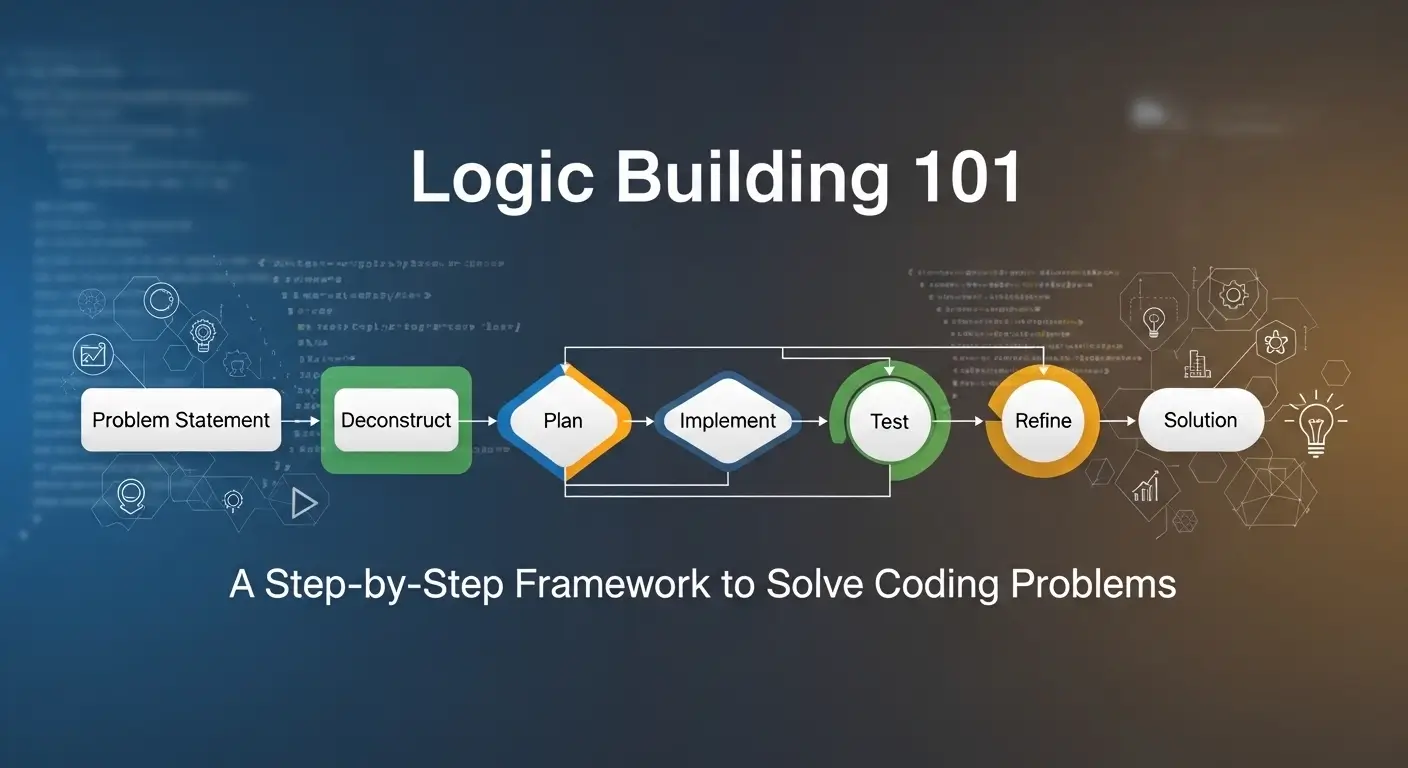
Logic Building 101: A Step-by-Step Framework to Solve Coding Problems

Published By
Bikki SinghMost beginners spend months learning syntax — loops, functions, arrays — and still freeze when they see a coding problem on LeetCode or in a technical interview. The reason is simple: syntax is not logic. Logic is the ability to break a problem into steps, recognize patterns, and implement a solution systematically.
This blog is a structured framework to develop exactly that. No motivational fluff — just a concrete, repeatable process you can apply to every coding problem you encounter, whether you're solving your first LeetCode Easy or preparing for an SDE interview at an MNC.
Read Also: If you're just starting out, check out How to Learn Coding from Scratch in 2025 — Step-by-Step Guide before diving into this framework.
The Core Problem: Why Beginners Struggle with Coding Logic
Before building the framework, let's diagnose the actual failure points in problem solving in programming:
- No structured reading approach — jumping to code without understanding the problem.
- Lack of pattern recognition — solving every problem as if it's brand new.
- Skipping dry runs — not tracing through logic manually before coding.
- Ignoring edge cases — code works for examples but breaks on real inputs.
- No optimization mindset — writing brute-force code and stopping there.
Each step in this framework directly addresses one of these failure points.
Read Also: Understand why most programmers plateau early → Why Most Beginners Fail in Coding (And How to Avoid It)
The 6-Step Framework for Coding Problem Solving
Step 1: Read the Problem — Not Just Once
The first step in any step-by-step coding approach is to read the problem statement at least twice. The goal is not to start solving immediately but to extract the following:
- Input format: What data is given? (array, string, integer, graph, etc.)
- Output format: What should be returned or printed?
- Constraints: What are the size limits? (
n ≤ 10^5?n ≤ 10^18?) - Edge cases: What happens with empty inputs, single elements, negative numbers?
Actionable Checklist:
- [ ] Identify input and output types
- [ ] Note the constraints (they hint at the required time complexity)
- [ ] List at least 2–3 edge cases before writing a single line of code
- [ ] Understand the examples given — trace through them manually
Step 2: Think in Examples Before Thinking in Code
A critical part of how to think while solving coding problems is to work through concrete examples yourself, not just the ones given in the problem.
Take a simple problem: Find the maximum subarray sum.
Before writing code, trace manually:
Input: [-2, 1, -3, 4, -1, 2, 1, -5, 4]

Manual trace:
- Start at -2 → current = -2, max = -2
- Add 1 → current = -1, max = -1
- Add -3 → current = -4 → reset? No, -4 < 0, so reset to 0
- At 4 → current = 4, max = 4
- At -1 → current = 3, max = 4
- At 2 → current = 5, max = 5
- At 1 → current = 6, max = 6 ✓
This manual trace forces your brain to discover the algorithm organically — which is exactly Kadane's Algorithm.
Actionable Points:
- Always create your own test cases, not just the problem examples.
- Include: normal case, empty/null case, all-negative case, single element case.
- Write the expected output before writing code.
Step 3: Identify the Problem Pattern (DSA Problem Solving Patterns)
One of the most powerful skills in DSA problem solving patterns is recognizing what kind of problem you're looking at. Most competitive coding problems fall into a finite set of patterns.
| Pattern | Trigger Keywords / Conditions | Common Technique |
| Sliding Window | Subarray/substring of fixed or variable size | Two pointers, max/min window |
| Two Pointers | Sorted array, pair/triplet sum, palindrome | Left/right pointer traversal |
| Binary Search | Sorted data, minimizing/maximizing a value | Mid-based search on answer |
| BFS/DFS | Trees, graphs, shortest path, connected regions | Queue (BFS), Stack/Recursion (DFS) |
| Dynamic Programming | Overlapping subproblems, optimal substructure | Memoization, Tabulation |
| Hashing | Frequency count, duplicate detection, O(1) lookup | HashMap / HashSet |
| Recursion + Backtracking | Permutations, subsets, N-Queens | DFS with undo state |
| Greedy | Interval scheduling, minimum cost, optimal local choice | Sort + pick best local option |
| Stack/Monotonic Stack | Next Greater Element, histogram problems | Stack with constraint |
| Heap / Priority Queue | Top-K elements, median in stream | Min-heap / Max-heap |
How to identify a pattern:
- See "maximum subarray" → think Kadane's (DP/Sliding Window)
- See "shortest path in unweighted graph" → BFS
- See "all subsets/permutations" → Backtracking
- See "k-th largest element" → Heap
Read Also: Get the full pattern guide for competitive programming → DSA Roadmap 2026: From Arrays to Dynamic Programming
Step 4: Write Pseudocode First, Then Code
This is the step most beginners skip — and it's why they get stuck mid-code. Pseudocode forces you to think about the algorithm in plain language before you worry about syntax.
Example Problem: Check if a string is a palindrome.
Pseudocode:
1. Take input string s
2. Set left = 0, right = length(s) - 1
3. While left < right:
   a. If s[left] != s[right] → return False
   b. Increment left, decrement right
4. Return True
Python Implementation:
def is_palindrome(s):
    left, right = 0, len(s) - 1
    while left < right:
        if s[left] != s[right]:
            return False
        left += 1
        right -= 1
    return True

# Test
print(is_palindrome("racecar"))   # True
print(is_palindrome("hello"))     # False
print(is_palindrome("a"))         # True (edge case: single char)
print(is_palindrome(""))          # True (edge case: empty string)
C++ Implementation:
#include <iostream>
#include <string>
using namespace std;

bool isPalindrome(string s) {
    int left = 0, right = s.length() - 1;
    while (left < right) {
        if (s[left] != s[right]) return false;
        left++;
        right--;
    }
    return true;
}

int main() {
    cout << isPalindrome("racecar") << endl;  // 1 (true)
    cout << isPalindrome("hello") << endl;    // 0 (false)
    return 0;
}
Actionable Points:
- Write pseudocode in plain English or bullet points, not code.
- Pseudocode should be detailed enough that converting it to code is mechanical.
- Once pseudocode is validated against examples, then write the actual code.
Step 5: Implement with Clean, Modular Code
When writing actual code, follow these coding best practices for logic development:
1. Use meaningful variable names:
# Bad
x = arr[l] + arr[r]

# Good
current_sum = arr[left_pointer] + arr[right_pointer]
2. Break complex logic into helper functions:
// Main function stays clean
public int maxProfit(int[] prices) {
    int minPrice = findMin(prices);
    return findMaxProfitFromMin(prices, minPrice);
}

private int findMin(int[] prices) {
    int min = Integer.MAX_VALUE;
    for (int price : prices) min = Math.min(min, price);
    return min;
}
3. Always handle edge cases explicitly:
def two_sum(nums, target):
    if not nums or len(nums) < 2:   # Edge case: empty or single element
        return []

    seen = {}
    for i, num in enumerate(nums):
        complement = target - num
        if complement in seen:
            return [seen[complement], i]
        seen[num] = i
    return []
Read Also: Learn how to avoid the most common code mistakes → Stop Breaking Your Own Code: 15 Common Python Mistakes Beginners Must Avoid
Step 6: Analyze Time & Space Complexity (Then Optimize)
Writing a working solution is step one. Writing an efficient solution is the actual goal. Every solution must be analyzed for:
- Time Complexity — how does runtime grow with input size?
- Space Complexity — how much extra memory does it use?
Quick Reference for Constraints:
| Constraint (n) | Acceptable Time Complexity |
| n ≤ 10 | O(n!) or O(2^n) — Brute force, backtracking |
| n ≤ 20 | O(2^n) — Bitmask DP |
| n ≤ 100 | O(n³) — Triple nested loops |
| n ≤ 10³ | O(n²) — Double nested loops |
| n ≤ 10⁵ | O(n log n) — Sorting, Binary search, Segment tree |
| n ≤ 10⁶ | O(n) — Single pass, Hashing |
| n ≤ 10⁹ | O(log n) — Binary search only |
Optimization Example — Two Sum:
# Brute Force: O(n²) time, O(1) space
def two_sum_brute(nums, target):
    for i in range(len(nums)):
        for j in range(i + 1, len(nums)):
            if nums[i] + nums[j] == target:
                return [i, j]

# Optimized: O(n) time, O(n) space — trade space for speed
def two_sum_optimized(nums, target):
    seen = {}   # value → index
    for i, num in enumerate(nums):
        if target - num in seen:
            return [seen[target - num], i]
        seen[num] = i
Understanding this trade-off between time and space is a core part of the programming mindset for DSA.
Algorithmic Thinking for Beginners: The Mental Models
Beyond the 6-step framework, strong algorithmic thinking for beginners requires developing specific mental models:
Mental Model 1: Reduction
Can this problem be reduced to a known problem? For example, "find the k-th smallest element" → reduce to a sorting problem or heap problem.
Mental Model 2: Inversion
Sometimes it's easier to count/solve the opposite of what's asked. "Count arrays that DON'T satisfy condition X" = Total - Arrays that DO satisfy X.
Mental Model 3: Invariants
Identify what remains constant during iteration. In binary search, the invariant is: the answer is always within [left, right].
Mental Model 4: State Representation
In DP and graph problems, ask: "What is my state?" For shortest path, state = (node, distance). For knapsack, state = (item_index, remaining_capacity).
How to Start Solving LeetCode Problems: A Practical Roadmap
If your goal is to build a competitive problem-solving habit, here's a structured beginner roadmap for problem solving:
Phase 1 — Foundation (Weeks 1–4):
- Arrays and Strings (Two Pointers, Sliding Window)
- HashMaps and HashSets
- Basic Recursion
- Target: 30–40 Easy problems
Phase 2 — Core DSA (Weeks 5–10):
- Linked Lists, Stacks, Queues
- Trees (BFS, DFS, LCA)
- Binary Search
- Target: 30 Medium problems
Phase 3 — Advanced Patterns (Weeks 11–16):
- Dynamic Programming (1D → 2D)
- Graphs (Dijkstra, Union-Find)
- Heap, Trie, Segment Tree
- Target: 20 Medium + 10 Hard problems
Daily Practice Formula:
1 new problem (untimed, full thought process)+ 1 revision problem (from past week)+ 15-min concept reading= 1 productive DSA session
Read Also: Build the right daily habit → Daily Coding Practice Routine for Beginners That Actually Works in 2026Read Also: Get placement-ready faster → Placement Preparation Roadmap 2026: How to Crack Your Dream Job in Final Year
Logic Building Exercises for Programmers (Practice Problems by Level)
Beginner (Logic Building Exercises)
- Reverse a string without using built-in functions
- Find duplicates in an array using O(n) time
- Check if two strings are anagrams
- Fibonacci series using iteration (not recursion)
- Count frequency of each character in a string
Intermediate
- Find the longest substring without repeating characters
- Merge two sorted arrays without extra space
- Check if a linked list has a cycle
- Binary search in a rotated sorted array
- Level-order traversal of a binary tree
Advanced
- Minimum window substring (Sliding Window + HashMap)
- Word search in a 2D grid (Backtracking)
- Number of islands (BFS/DFS on 2D grid)
- Longest increasing subsequence (DP)
- Serialize and deserialize a binary tree
Read Also: Learn how to crack coding interviews in technical rounds → How to Prepare for Technical Interviews at Home Without Coaching in 2026
Read Also: Top questions asked in MNC rounds → Top Coding Interview Questions Asked in MNCs: How to Crack the Technical Round in 2026
Common Mistakes to Avoid in Coding Interview Problem Solving
- Starting to code in the first 2 minutes. Always spend at least 5 minutes understanding and planning before writing.
- Not communicating your thought process. In interviews, thinking aloud is evaluated — not just the final code.
- Ignoring the constraints.
n ≤ 10^9rules outO(n²).Read the constraints and let them guide your approach. - Writing code before pseudocode. Leads to mid-solution confusion and rewrites.
- Not testing your own code. Manually trace through at least 2 test cases after writing the solution.
Summary: The Logic Building Framework at a Glance
| Step | Action | Goal |
| 1 | Read the problem twice, extract constraints | Understand the problem completely |
| 2 | Trace through examples manually | Discover the algorithm organically |
| 3 | Identify the pattern | Avoid solving from scratch |
| 4 | Write pseudocode | Design before implementing |
| 5 | Write clean, modular code with edge cases | Correct implementation |
| 6 | Analyze complexity and optimize | Production-ready, efficient solution |
Logic building for coding is not a talent — it is a trained skill. Every coder who looks fast and intuitive has simply run this process hundreds of times until it became automatic. Start slow, follow the framework, and consistency will compound.
Frequently Asked Questions (FAQs)
Q1: How do I improve my logic building for coding as an absolute beginner?
Start with basic problems on arrays and strings. Focus on the thinking process, not just getting the answer. After solving a problem, read 2–3 different approaches. The goal is to expand your pattern library, not just solve one problem.
Q2: How many problems should I solve daily to improve coding logic?
Quality over quantity. Solving 1–2 problems deeply — understanding time/space complexity, alternate approaches, and edge cases — is more effective than rushing through 10 problems superficially.
Q3: Is pseudocode really necessary before writing actual code?
Yes, especially for medium and hard problems. Pseudocode forces you to design the algorithm before worrying about syntax. It significantly reduces debugging time because your logic is validated before implementation.
Q4: What are the most important DSA problem-solving patterns for placements?
For MNC placements, focus on: Arrays/Strings, Two Pointers, Sliding Window, Binary Search, Trees (BFS/DFS), Dynamic Programming (1D), and Hashing. These cover 80%+ of questions asked in campus drives.
Q5: How do I develop algorithmic thinking if I keep getting stuck on problems?
When stuck, do not immediately look at the solution. First try: (a) work through a smaller example by hand, (b) identify if it resembles a known pattern, (c) think about what information you need at each step. Only look at hints after 20–30 minutes of genuine effort.
Related Tags:
logic building for coding
coding problem solving framework
how to improve coding logic
problem solving in programming
step by step coding approach
coding interview problem solving
DSA problem solving patterns
logic building exercises for programmers
how to think while solving coding problems
coding patterns for beginners
beginner roadmap for problem solving
algorithmic thinking for beginners
coding logic development tips
how to start solving LeetCode problems
programming mindset for DSA


Hi, I'm Bikki Singh — Full Stack Developer, coding language trainer, and founder of CodePractice.in. With 5+ years of hands-on web development experience, I've trained 500+ students across India in Python, PHP, Java, C, C++, MySQL, and front-end technologies like HTML, CSS, and JavaScript. I started CodePractice.in with one goal: make programming education practical, not theoretical. Every tutorial and blog I write is built around real projects and interview scenarios — so learners don't just understand code, they can actually use it.


Read Coding Blogs on Different Topics
Learn Our Free Tutorials on

Submit Your Reviews