POPULAR
Instant Online HTML Formatter
NEW TOOL
Try our Interactive Python Online Playground!
FEATURED
HTML, CSS & JS Live Code Playground
POPULAR
Try Our Online Code Editor and Compiler
POPULAR
Instant Online HTML Formatter
NEW TOOL
Try our Interactive Python Online Playground!
FEATURED
HTML, CSS & JS Live Code Playground
POPULAR
Try Our Online Code Editor and Compiler

DSA Roadmap 2026: From Arrays to Dynamic Programming (The Complete Guide)

Published By
Bikki Singh📑 Table of Contents
- Phase 1: The Mathematics of Efficiency (Complexity Analysis)
- Phase 2: Linear Data Structures (The Foundation)
- Phase 3: Restricted Access Structures (Stacks and Queues)
- Phase 4: Non-Linear Structures (Trees and Graphs)
- Phase 5: Recursion and Backtracking Learning Path
- Phase 6: Arrays to Dynamic Programming Masterclass
- Phase 7: Hashing and Heaps (The Performance Boosters)
- Phase 8: The 2026 Roadmap Strategy (Best Resources)
- Conclusion
In this DSA Roadmap 2026, we provide a structured, technical path for college students and job seekers to move from basic Arrays to Dynamic Programming. This guide covers the essential Step-by-step DSA syllabus for 2026, focusing on Logic building in programming roadmap, Time and Space complexity tutorial, and Coding interview patterns 2026. You will learn how to approach Top product based company interview questions and follow a clear MAANG interview preparation guide to crack DSA for SDE 1 roles.
Many students start their journey but get stuck in the "Tutorial Hell" phase. This blog is designed to break that cycle by focusing on implementation, mental models, and the exact patterns used by engineers at Google, Amazon, and Microsoft.
Phase 1: The Mathematics of Efficiency (Complexity Analysis)
A senior developer is not someone who writes code that works; they are someone who writes code that scales. This is the core of the Time and Space complexity tutorial.
1.1 What is Big O Notation ($O$)
In 2026, with the rise of distributed systems, understanding complexity is non-negotiable. Big O defines the upper bound of an algorithm's execution time.
- Constant Time $O(1)$: The ideal. Accessing an element in an array via index or pushing into a stack.
- Logarithmic Time $O(\log n)$: The hallmark of "Divide and Conquer." If your search space halves every step (like Binary Search), you are in the log territory.
- Linear Time $O(n)$: A single pass. Finding the maximum element in an unsorted array.
- Linearithmic Time $O(n \log n)$: The efficiency of modern sorting algorithms like Merge Sort and Quick Sort.
- Quadratic Time $O(n^2)$: Usually acceptable for $N < 5000$, but a red flag for larger datasets. Think Nested Loops.
- Exponential Time $O(2^n)$: The brute-force recursion zone (e.g., recursive Fibonacci).
1.2 Space Complexity & The Memory Stack
You must distinguish between Total Space Complexity and Auxiliary Space.
- Auxiliary Space: The extra space used by the algorithm (e.g., a visited array in Graphs).
- Input Space: The space occupied by the input itself.
Key Implementation Steps:
- Identify constraints: If $N = 10^5$, your algorithm must be $O(n)$ or $O(n \log n)$. $O(n^2)$ will give a Time Limit Exceeded (TLE) error.
- Explain during interviews: Don't just say "Big O of N." Explain why it is $N$ based on the loop structure.
Go In-Depth: C Programming Complete Guide for Beginners
Phase 2: Linear Data Structures (The Foundation)
This is where your DSA Roadmap 2026 for beginners starts. These structures store data in a linear sequence.
2.1 Arrays and Strings
Arrays are blocks of contiguous memory. In 2026, interviewers have moved past simple array traversals. They now focus on Coding interview patterns 2026.
- Two Pointers Pattern: Used for searching pairs in a sorted array. One pointer starts at the beginning, one at the end.
- Sliding Window Pattern: Used for sub-array problems. Instead of nested loops, you "slide" a window of size $K$ to find the optimal result in $O(n)$.
- Prefix Sum: Pre-calculating sums to answer range-sum queries in $O(1)$.
2.2 Linked Lists: Breaking the Contiguous Barrier
Linked Lists are nodes connected by pointers. They solve the "fixed size" problem of arrays but lose "random access."
- Singly Linked List: Forward navigation only.
- Doubly Linked List: Forward and backward navigation (used in Browser History or LRU Cache).
- Circular Linked List: The last node points back to the head (used in Round Robin scheduling).
Comparison: Arrays vs. Linked Lists
| Feature | Arrays | Linked Lists |
| Storage | Contiguous Memory | Random Memory Locations |
| Access | $O(1)$ via Index | $O(n)$ via Traversal |
| Insertion | $O(n)$ (Shifting required) | $O(1)$ (Pointer update) |
| Search | $O(1)$ if sorted (Binary) | $O(n)$ always |
| Overhead | None | Extra memory for Pointers |
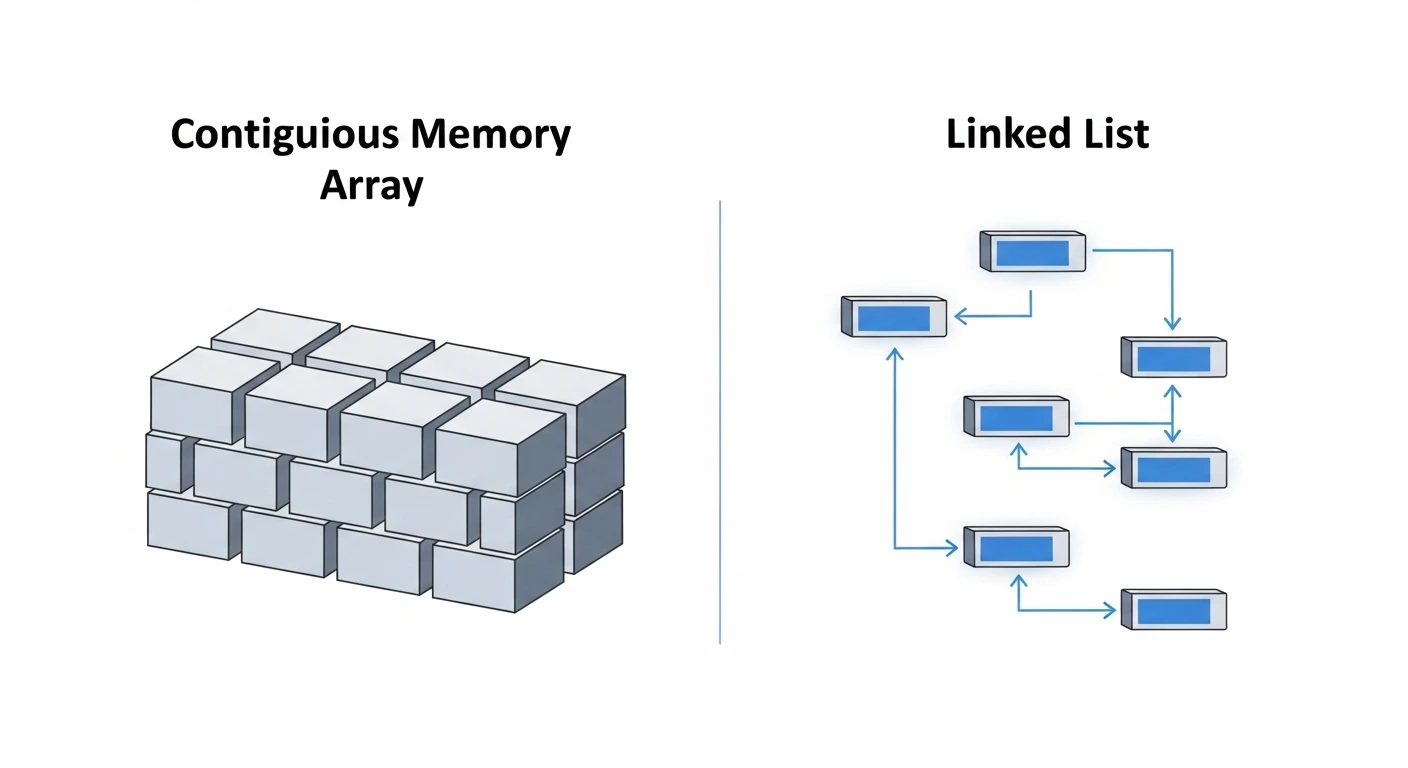
Mentor’s Pro-Tip:
- Implement "Reverse a Linked List" iteratively and recursively. It is the most common DSA for SDE 1 roles question.
- Solve the "Middle of Linked List" using the Slow and Fast pointer logic.
Go In-Depth: Python Programming Complete Guide for Beginners
Phase 3: Restricted Access Structures (Stacks and Queues)
These structures enforce a strict order of operations, which is essential for many LeetCode patterns for beginners 2026.
3.1 Stacks (Last In, First Out)
The Stack is the backbone of recursion. Every time a function is called, it is pushed onto the System Stack.
- Key Operations: Push, Pop, Peek.
- Real-world Logic: Undo/Redo in editors, balanced parentheses in compilers.
- Advanced Pattern: Monotonic Stack. This is used to find the "Next Greater Element" in $O(n)$ by maintaining a stack in increasing or decreasing order.
3.2 Queues (First In, First Out)
Queues handle processing in the order of arrival.
- Standard Queue: Basic FIFO.
- Circular Queue: Efficiently utilizes memory by connecting the end back to the start.
- Priority Queue: Elements are removed based on priority (usually implemented using Heaps).
- Deque: Double-Ended Queue where insertion/deletion happens from both ends.
Things to Practice Now:
- Practice implementing a Stack using two Queues and vice-versa. This is a classic Top product based company interview questions logic test.
- Understand the internal working of the collection framework you use.
Phase 4: Non-Linear Structures (Trees and Graphs)
Once you master linear structures, you must move to hierarchical data. This is where most students get filtered out in MAANG interview preparation guide rounds.
4.1 Binary Trees and Binary Search Trees (BST)
A Tree is a collection of nodes where each node has a value and pointers to children.
- Traversal Techniques:
-
- Level Order (BFS): Uses a Queue to visit nodes level by level.
- Depth First Search (DFS): In-order (Left-Root-Right), Pre-order (Root-Left-Right), and Post-order (Left-Right-Root).
- BST Property: For every node,
Left Child < Node < Right Child. This allows for $O(\log n)$ searching.
4.2 Graphs: The Networking Giant
A Graph is a set of vertices ($V$) and edges ($E$). It is used to represent everything from Facebook friends to airline routes.
- Representation: Adjacency Matrix ($O(V^2)$ space) vs. Adjacency List ($O(V+E)$ space).
- Essential Algorithms:
-
- BFS: Finding the shortest path in an unweighted graph.
- DFS: Exploring all paths or detecting cycles.
- Dijkstra's: Finding the shortest path in a weighted graph using a Priority Queue.
- Disjoint Set Union (DSU): Crucial for "Kruskal's Algorithm" to find the Minimum Spanning Tree.
Key Implementation Steps:
- In Tree problems, always consider the "Recursive Leap of Faith." If you can solve for the left and right subtrees, can you solve for the root?
- Learn how to identify a "Graph in Disguise" (e.g., a matrix where you can move up, down, left, right).
Read Also: Placement Preparation Roadmap for Students
Phase 5: Recursion and Backtracking Learning Path
Recursion is not just a topic; it is a way of thinking. This is the Logic building in programming roadmap core.
5.1 The Anatomy of Recursion
Every recursive function must have:
- Base Case: The condition where recursion stops. Without this, you get a
StackOverflowError. - Recursive Call: Calling the same function with a smaller version of the problem.
- Self Work: The logic you perform at the current level.
Recursive Power Function ($a^b$)
// Professional approach: $O(\log b)$ instead of $O(b)$
long long power(int a, int b) {
    if (b == 0) return 1; // Base Case

    long long half = power(a, b / 2);
    if (b % 2 == 0) return half * half;
    else return a * half * half;
}- Logic Explanation: Instead of multiplying $a$, $b$ times, we calculate $a^{b/2}$ and square it. This reduces complexity from $O(n)$ to $O(\log n)$.
5.2 Backtracking: The Systematic Search
Backtracking is used when you have multiple choices and you need to find one or all solutions that satisfy certain constraints.
- The Blueprint: Choose $\rightarrow$ Explore $\rightarrow$ Un-choose (Backtrack).
- Classic Problems: N-Queens, Sudoku Solver, Generating all Permutations.
Mentor’s Pro-Tip:
- Stop trying to trace deep recursion on paper. Only trace the first 2-3 levels to verify the logic.
Read Also: C++ Programming Complete Guide for Beginners
Phase 6: Arrays to Dynamic Programming Masterclass
Dynamic Programming (DP) is the most feared topic in Advanced Graph and DP patterns. But DP is simply "Smart Recursion."
6.1 Identifying a DP Problem
If a problem asks for "Maximum," "Minimum," "Total Ways," or "Optimal Value," it is likely DP. It must satisfy:
- Overlapping Sub-problems: You are calculating the same thing multiple times (e.g., $Fib(3)$ is needed for $Fib(4)$ and $Fib(5)$).
- Optimal Substructure: The answer to a larger problem depends on the answers to smaller sub-problems.
6.2 The DP Toolbox: Memoization vs. Tabulation
- Memoization (Top-Down): Keep the recursive structure. Add an array (usually called
dp[]) to store results. Before a recursive call, check if the value exists indp[]. - Tabulation (Bottom-Up): Eliminate recursion. Fill the
dp[]table iteratively starting from the base case.
6.3 Must-Solve DP Patterns for 2026
- 0/1 Knapsack Pattern: Items can either be picked or not.
- Unbounded Knapsack: Items can be picked multiple times (e.g., Coin Change).
- Longest Common Subsequence (LCS): Comparing two strings.
- DP on Grids: Finding paths from $(0,0)$ to $(m,n)$ with obstacles.
Key Implementation Steps:
- Always write the recursive solution first. Optimization (adding memoization) takes only 2 minutes once the recursion is correct.
Read Also: Best Coding Practice Routine for Students
Phase 7: Hashing and Heaps (The Performance Boosters)
To crack DSA for SDE 1 roles, you need to know how to optimize $O(n)$ searches into $O(1)$ lookups.
7.1 Hashing (HashMap and HashSet)
Hashing maps keys to values using a Hash Function.
- Logic: It provides average-case $O(1)$ time for Search, Insert, and Delete.
- Collision Handling: Chaining (using Linked Lists) and Open Addressing.
- Interview Tip: If you see a problem involving "duplicates" or "frequency," Hashing is your best friend.
7.2 Heaps (Priority Queues)
A Heap is a complete binary tree used to find the Min or Max element in $O(1)$.
- Min-Heap: Smallest element at the root.
- Max-Heap: Largest element at the root.
- Logic: Insertion and Deletion take $O(\log n)$.
- Top 2026 Pattern: K-Way Merge and Top K Frequent Elements.
Mentor’s Pro-Tip:
- Use a Max-Heap to find the $K^{th}$ smallest element and a Min-Heap to find the $K^{th}$ largest element.
Read Also: CSS Grid vs Flexbox: Which One to Use?
Phase 8: The 2026 Roadmap Strategy (Best Resources)
Following a Step-by-step DSA syllabus for 2026 requires discipline. Here is how you should structure your weeks:
8.1 Month 1-2: Language and Linear Structures
- Pick C++ or Java. (C++ is preferred for competitive programming, Java for SDE roles).
- Solve 50-60 problems on Arrays, Strings, and Linked Lists.
- Focus on Time and Space complexity tutorial principles for every problem.
8.2 Month 3: Non-Linear and Recursion
- Master Binary Trees and BSTs.
- Start the Recursion and Backtracking learning path.
- Don't skip Heaps—they are frequently asked in the first technical round.
8.3 Month 4: Advanced Algorithms (Graphs and DP)
- Solve 30 problems on Graphs (BFS/DFS/Dijkstra).
- Solve 40 problems on DP (focus on the 5-6 core patterns).
- Focus on Advanced Graph and DP patterns.
8.4 Month 5: Mock Interviews and Revision
- Use LeetCode’s "Company Wise" tags.
- Give mock interviews on platforms like Pramp or Peer-to-peer sessions.
- Review your notes on Coding interview patterns 2026.
Conclusion
The journey from Arrays to Dynamic Programming is not a sprint; it’s a marathon. In 2026, companies are looking for "Thinkers" not "Coders." Use this DSA Roadmap 2026 to build your logical foundation. Focus on the why of every data structure, practice clean coding, and follow the actionable points provided in this guide.
Read Also: Python Data Engineering Toolkit Roadmap
Consistency is the only secret. If you solve 2-3 problems every day for 6 months, you will be ahead of 95% of candidates.
🔥 Get Free Weekly Coding Cheatsheets & Guides
Join 10,000+ developers getting handpicked Python, Web Dev & CS interview prep guides directly in their inbox.
Frequently Asked Questions (FAQs)
Q1: Is DSA still relevant in 2026 with AI tools like ChatGPT and GitHub Copilot?
Yes, DSA is more relevant than ever. While AI can write code, an SDE's job is to design efficient systems and debug complex logic. Product-based companies use DSA to test your problem-solving ability and your understanding of computer memory and performance, which AI cannot replace.
Q2: Which language is best for the DSA Roadmap 2026 for beginners?
For beginners, C++ and Java are the best choices. C++ provides a deep understanding of memory (pointers) and has a fast STL. Java is highly used in corporate environments and has a robust Collections Framework. Python is good for rapid prototyping but can sometimes hide the underlying complexity that interviewers want to see.
Q3: How many problems should I solve to be ready for MAANG?
Quality over quantity. Instead of solving 1000 random problems, focus on solving 300-400 high-quality problems covering all Coding interview patterns 2026. If you can solve a new problem by identifying its pattern (e.g., "This is a Sliding Window problem"), you are ready.
Q4: What is the most important topic in the Step-by-step DSA syllabus for 2026?
While all topics are important, Arrays, Hashing, and Trees form the bulk of interview questions. However, for high-paying SDE 1 roles, Graphs and Dynamic Programming are usually the "deciding" rounds.
Q5: Where can I find the best resources for DSA 2026?
For practice, LeetCode and CodeStudio are excellent. For learning, follow high-quality technical blogs (like CodePractice.in), documentation, and standard textbooks like "Introduction to Algorithms" (CLRS) for deep theory.
Related Tags:
DSA Roadmap 2026 for beginners
Arrays to Dynamic Programming masterclass
Coding interview patterns 2026
Data structures and algorithms roadmap in Hinglish
Step-by-step DSA syllabus for 2026
How to master DP for interviews
Top product based company interview questions
DSA for SDE 1 roles
LeetCode patterns for beginners 2026
Recursion and Backtracking learning path
MAANG interview preparation guide
Logic building in programming roadmap
Best resources for DSA 2026
Time and Space complexity tutorial
Advanced Graph and DP patterns


Hi, I'm Bikki Singh — Full Stack Developer, coding language trainer, and founder of CodePractice.in. With 5+ years of hands-on web development experience, I've trained 500+ students across India in Python, PHP, Java, C, C++, MySQL, and front-end technologies like HTML, CSS, and JavaScript. I started CodePractice.in with one goal: make programming education practical, not theoretical. Every tutorial and blog I write is built around real projects and interview scenarios — so learners don't just understand code, they can actually use it.


Read Coding Blogs on Different Topics
Learn Our Free Tutorials on

Submit Your Reviews