POPULAR
Instant Online HTML Formatter
NEW TOOL
Try our Interactive Python Online Playground!
FEATURED
HTML, CSS & JS Live Code Playground
POPULAR
Try Our Online Code Editor and Compiler
POPULAR
Instant Online HTML Formatter
NEW TOOL
Try our Interactive Python Online Playground!
FEATURED
HTML, CSS & JS Live Code Playground
POPULAR
Try Our Online Code Editor and Compiler

From Zero to Hero: C++ Roadmap for Placement Success in 2026

Published By
Bikki Singh📑 Table of Contents
The year is 2026. The tech landscape keeps evolving, but one language remains a titan in the world of high-performance computing, systems programming, and, crucially, competitive programming for top-tier product-based companies: C++. If you’re eyeing a Software Development Engineer (SDE-1) role at a FAANG or MAANG company, or any firm that values robust, efficient code, then mastering C++ isn't just an option—it's your strategic advantage.
This isn't just another C++ tutorial. This is your Zero-to-Hero C++ Roadmap, a practical, no-nonsense guide designed to take you from a beginner to an interview-ready C++ expert. We’ll cover everything you need, from foundational C++ Syntax to advanced Modern C++ for Placements, ensuring you’re equipped for the challenges ahead.
Why C++ for Placements in 2026? The Unbeatable Edge
You might hear whispers about Python's popularity or Rust's rising star. So, Is Coding Still a Good Career in 2026? The Raw Truth from a Mentor is a valid question you might ask yourself. While other languages have their merits, C++ offers unparalleled control over system resources, making it indispensable for domains like game development, operating systems, embedded systems, and high-frequency trading. More importantly, its performance characteristics and the deep understanding it demands make it a litmus test for strong problem-solving skills in coding interviews.
Recruiters at leading tech companies know that if you can conquer C++, you possess a solid grasp of computer science fundamentals, efficient algorithm implementation, and memory management – skills that are transferable across any language or platform. This makes C++ a powerful choice, especially when combined with a strong understanding of Data Structures and Algorithms (DSA).
The 5-Level Placement Blueprint: A Strategic C++ Roadmap to Becoming Interview-Ready by 2026
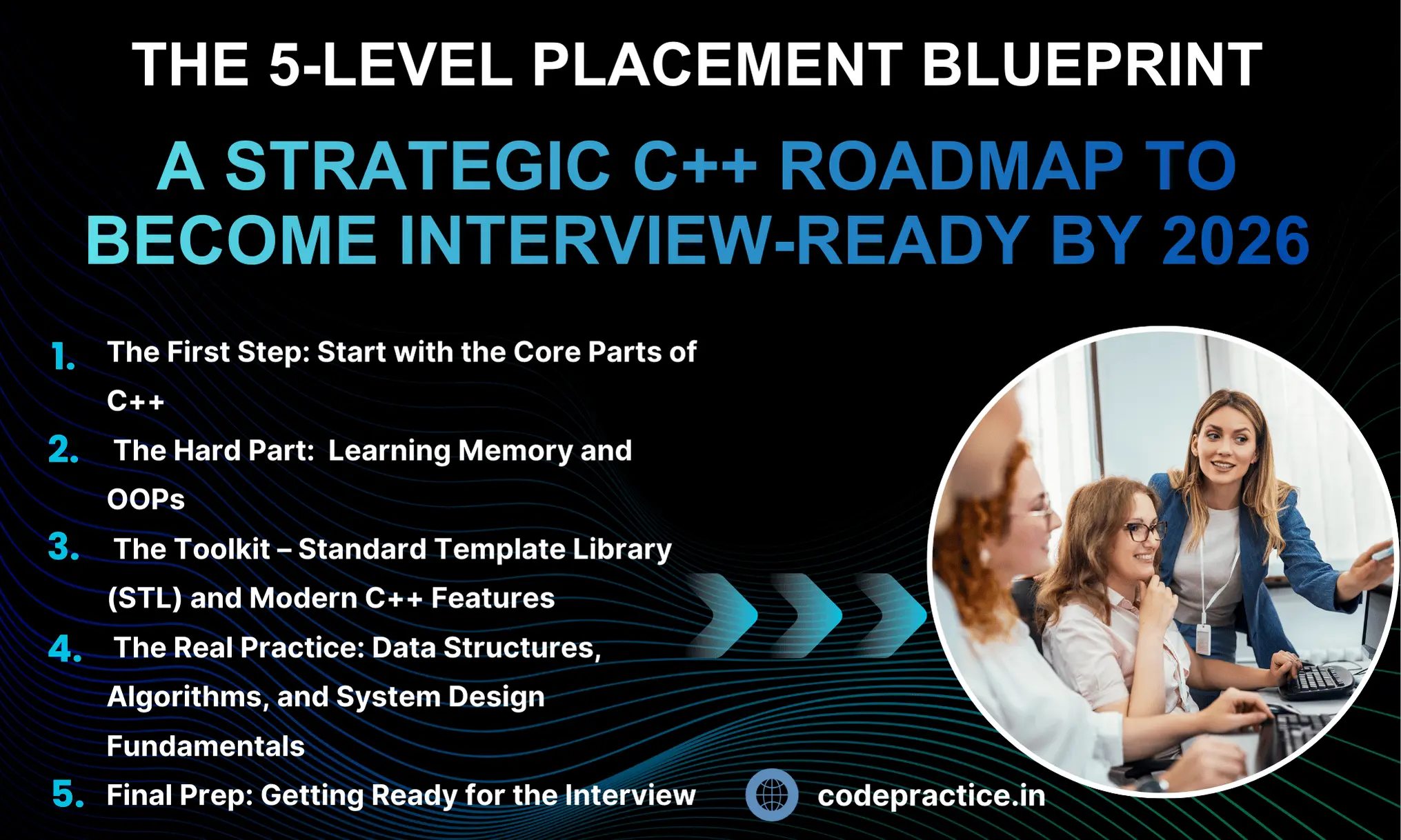
Level 1: The First Steps: Start with the Core Parts of C++
Before you can build skyscrapers, you need a rock-solid foundation. This initial phase is about getting comfortable with the language's basic building blocks. Don't rush this; true mastery stems from understanding the fundamentals deeply.
If you’re starting from scratch, begin with a comprehensive C++ Programming Tutorial for Beginners | Learn C++ from Scratch.
Chapter 1.1: C++ Syntax and Basic Constructs
-
Variables, Data Types, and Operators: Understand how to declare variables, different data types (int, float, char, bool, etc.), and arithmetic, relational, and logical operators.
-
Control Flow Statements: Master
if-else,switch,for,while, anddo-whileloops. These are your bread and butter for any programming logic. -
Functions: Learn to define and call functions, pass arguments, and understand return types. Grasp function overloading early.
-
Arrays and Strings: Get comfortable with one-dimensional and multi-dimensional arrays. Dive into C-style strings and, more importantly,
std::string.
Avoid These C++ Mistakes: Many beginners stumble by glossing over these basics. Ensure you write small programs for each concept. This isn't about memorizing syntax; it's about building muscle memory for problem-solving.
Level 2: The Hard Parts: Learning Memory and OOPs
Once you've got the basics down, it’s time to move into the heart of C++: how it handles memory and its powerful Object-Oriented Programming (OOPs) paradigm. This is where you truly start to differentiate yourself.
Chapter 2.1: Pointers and References – The C++ Superpower
-
Pointers: This is often a make-or-break topic for beginners. Understand what a pointer is, how to declare and initialize it, dereference it, and perform pointer arithmetic. Grasp
nullptr. -
References: Learn the distinction between pointers and references, their use cases, and how they offer safer alternatives in many scenarios.
-
Dynamic Memory Allocation: Use
newanddeleteto allocate and deallocate memory on the heap. This is crucial for efficient resource management.
Chapter 2.2: OOPs Concepts in C++ – Building Real-World Systems
Object-Oriented Programming is not just a buzzword; it’s a design philosophy that structures complex programs into manageable, reusable components. Interviewers will relentlessly quiz you on this.
-
Classes and Objects: Understand how to define a class, create objects, and differentiate between member variables and member functions.
-
Encapsulation: Learn to bundle data and methods that operate on the data within a single unit, restricting direct access using
public,private, andprotectedaccess specifiers. -
Inheritance: Grasp how new classes (derived classes) can inherit properties and behaviors from existing classes (base classes), promoting code reuse. Understand different types of inheritance.
-
Polymorphism: This means "many forms." Dive into function overloading (already covered), operator overloading, and, most critically, runtime polymorphism using virtual functions and abstract classes.
-
Abstraction: Understand how to hide complex implementation details and show only the necessary features of an object.
-
Constructors and Destructors: Learn their roles in object initialization and cleanup.
C++ OOPs Interview Questions for Amazon and Microsoft often revolve around real-world scenarios where these principles apply. Be ready to explain "Why use a virtual destructor?" or "When is multiple inheritance problematic?"
Level 3: The Toolkit – Standard Template Library (STL) and Modern C++ Features
This is where you gain immense power and efficiency. The Standard Template Library (STL) is a collection of powerful, generic classes and functions that will significantly speed up your coding. Simultaneously, Modern C++ for Placements (C++11, C++14, C++17, and even C++20 features) introduces incredibly useful constructs that streamline code and prevent common errors.
Chapter 3.1: C++ STL for Competitive Programming – Your Best Friend
The STL is not just a library; it’s a way of thinking about efficient data handling. Mastering it is non-negotiable for DSA with C++ Roadmap 2026.
-
Containers:
-
Sequences:
std::vector,std::deque,std::list. Understand their underlying implementations, time complexities for operations, and when to use each.std::vectoris your primary workhorse. -
Associative Containers:
std::map,std::set,std::multimap,std::multiset. Grasp the concept of ordered vs. unordered containers (std::unordered_map,std::unordered_set) and their performance characteristics. -
Container Adapters:
std::stack,std::queue,std::priority_queue.
-
-
Iterators: Learn how iterators work as generalized pointers, traversing through containers.
-
Algorithms:
std::sort,std::find,std::lower_bound,std::upper_bound,std::accumulate, etc. Don't reinvent the wheel; the STL provides highly optimized algorithms. -
Functors (Function Objects): Understand how to pass functions as arguments, which ties into advanced algorithm usage.
Best C++ STL Functions for Coding Rounds: Focus on std::sort, std::binary_search, std::vector operations like push_back, pop_back, resize, and std::map/std::unordered_map for efficient lookups.
Chapter 3.2: Modern C++ Features (C++11/14/17/20)
Product companies expect you to write clean, maintainable, and robust code. Modern C++ features enable this.
-
Auto Keyword: Simplify type declarations.
-
Range-Based For Loops: Clean and concise iteration over containers.
-
Smart Pointers (RAII):
std::unique_ptr,std::shared_ptr,std::weak_ptr. These are critical for Memory Management & Smart Pointers and for preventing memory leaks. Understanding RAII (Resource Acquisition Is Initialization) is a hallmark of good C++ design. -
Lambda Expressions: Anonymous functions that are incredibly useful for competitive programming and custom predicate passing to algorithms.
-
Move Semantics (Rvalue References): Understand
std::moveandstd::forwardfor optimizing performance by avoiding unnecessary copies. -
std::optional,std::variant,std::any: C++17 additions for safer and more expressive code. -
Structured Bindings: Simplify unpacking values from structs, arrays, or tuples.
Why C++ vs Rust for Placements: While Rust offers memory safety guarantees, C++'s ecosystem, established tooling, and vast existing codebase mean it's not going anywhere soon, especially for performance-critical legacy systems and competitive programming. Both are excellent, but C++ is more commonly assessed in SDE-1 interviews currently.
Level 4: The Real Practice: Data Structures, Algorithms, and System Design Fundamentals
This is the phase where theory meets practice. Your understanding of C++ becomes the vehicle for implementing efficient solutions to complex problems. This is the core of How Much Coding Practice Is Enough to Get a Job? The 2026 Roadmap to Mastery.
Chapter 4.1: Data Structures and Algorithms (DSA) with C++
This is the most crucial part of your preparation. Every major tech company uses DSA as its primary filter.
-
Time and Space Complexity: Master how to analyze the efficiency of your algorithms. This is often the first question an interviewer asks.
-
Arrays & Strings: Advanced problems involving rotations, searching, character manipulations, and hashing.
-
Linked Lists: Singly, doubly, and circular linked lists. Problems on reversal, merging, cycle detection.
-
Stacks & Queues: Implementations and applications (e.g., balanced parentheses, next greater element, BFS).
-
Trees: Binary Trees, Binary Search Trees (BSTs), AVL Trees, Red-Black Trees. Traversal techniques (Inorder, Preorder, Postorder, Level Order), lowest common ancestor, path sum.
-
Heaps: Min-Heaps and Max-Heaps. Priority queues.
-
Graphs: Representation (adjacency list/matrix), Traversal (BFS, DFS), Shortest Path Algorithms (Dijkstra, Bellman-Ford, Floyd-Warshall), Minimum Spanning Tree (Prim's, Kruskal's), Topological Sort.
-
Hashing: Hash tables, collision resolution.
-
Recursion and Backtracking: Essential for problems like permutations, combinations, N-Queens.
-
Dynamic Programming (DP): Often the most challenging but rewarding topic. Master the approach for overlapping subproblems and optimal substructure.
Striver SDE Sheet C++ or similar curated problem sets are excellent resources for structuring your DSA practice. LeetCode C++ Solutions will become your daily routine.
Chapter 4.2: Low-Level Design (LLD) in C++
While System Design is usually for more senior roles, understanding Low-Level Design (LLD) in C++ is increasingly important for SDE-1 roles. This involves designing the components of a system, focusing on classes, objects, and their interactions.
-
Design Patterns: Learn common C++ Design Patterns (Singleton, Factory, Observer, Strategy, Decorator). Being able to apply these in small-scale design problems shows maturity.
-
UML Diagrams: Basic understanding of Class Diagrams for representing your design.
-
Principles: SOLID principles (Single Responsibility, Open/Closed, Liskov Substitution, Interface Segregation, Dependency Inversion).
-
Concurrency & Multithreading in C++: Basic understanding of threads, mutexes, condition variables, and
std::async/std::futurefor parallel execution. This is a common differentiator.
Level 5: Final Prep: Getting Ready for the Interview
You've built the skills; now it's time to ace the interview. This is about presentation, communication, and mock practice.
Chapter 5.1: The Practice Marathon
-
Consistent Coding Practice: Your Daily Coding Practice Routine for Beginners That Actually Works in 2026 should involve solving at least 2-3 problems daily. Don’t just solve; understand the optimal solution, edge cases, and time/space complexity.
-
Mock Interviews: Crucial for simulating the actual interview environment. Practice explaining your thought process out loud. Join platforms for peer interviews or find mentors.
-
Behavioral Questions: Prepare for questions about teamwork, challenges, failures, and successes. Your technical skills get you the interview; your behavioral skills get you the job.
Last Minute C++ Revision: Create your own "C++ Placement Cheat Sheet" with key concepts, common algorithms, and complexity tables. This will be invaluable in the final days before your interviews.
Chapter 5.2: Resources for Your 2026 C++ Journey
-
Online Judges: LeetCode, HackerRank, Codeforces, TopCoder, GeeksForGeeks (GFG C++ Guide).
-
Books: "Effective C++" by Scott Meyers, "A Tour of C++" by Bjarne Stroustrup (for Modern C++), "Cracking the Coding Interview" by Gayle Laakmann McDowell.
-
Online Courses: Reputable platforms offering DSA with C++ courses.
-
Community: Engage in forums, discuss problems, and learn from others.
Why Most Beginners Fail in Coding (And How to Avoid It)
A common pitfall is getting stuck in "tutorial hell" or only watching solution videos without writing code. Another is fearing complex topics like pointers or DP. This roadmap is designed to guide you away from these pitfalls. Embrace challenges, write code, and iterate.
Conclusion: Your C++ Placement Journey Awaits
The C++ Roadmap for Placement Preparation in 2026 isn’t a sprint; it’s a marathon. It demands dedication, consistent effort, and a structured approach. But the rewards – securing a dream SDE-1 role at a top-tier company – are immense.
By following this guide, focusing on Modern C++ for Placements, truly mastering DSA with C++ Roadmap 2026, and diligently practicing, you’re not just learning a language; you're cultivating a problem-solving mindset that will serve you throughout your career.
Start today. Your future self will thank you.
🔥 Get Free Weekly Coding Cheatsheets & Guides
Join 10,000+ developers getting handpicked Python, Web Dev & CS interview prep guides directly in their inbox.
Frequently Asked Questions (FAQs)
Q1: Is C++ still a good choice for placements in 2026?
Yes, C++ is still one of the best languages for getting a job at top tech companies. While Python is popular for AI, most big companies like Google or Amazon still use C++ for their core systems because it is incredibly fast. If you want to do competitive programming or clear tough coding rounds, C++ gives you an edge because its tools, like the STL, help you solve complex problems much quicker than other languages.
Q2: How much time do I need to learn C++ for an interview?
You generally need about 4 to 6 months to be fully ready. Spend the first month getting comfortable with how the language works and how to handle memory. After that, the next 3 to 5 months should be all about practicing data structures and solving problems on sites like LeetCode or GeeksforGeeks. If you already know another language, you can probably get interview-ready in about 3 months.
Q3: What are the most important C++ topics for a fresher?
The most important things to know are how memory works, how to use pointers, and the basics of Object-Oriented Programming like classes and inheritance. You also need to be very good with the Standard Template Library (STL), especially things like vectors and maps, because they save you from writing a lot of extra code during a live interview. Most interviewers will focus on these areas to see if you actually understand the logic behind your code.
Q4: Do I need to learn the newest versions of C++ like C++20?
You don't need to be an expert in every new update, but you should know the basics of "Modern C++" features from C++11 onwards. Knowing how to use things like auto for variables or smart pointers shows the interviewer that you aren't just memorizing old textbooks. It makes your code cleaner and proves that you are keeping up with how professional developers actually write code today.
Q5: Can I clear a Google or Microsoft interview using only C++?
Yes, you definitely can. These companies don't usually care which language you use as long as you can solve the problem efficiently. In fact, many interviewers prefer C++ because it shows you aren't afraid of managing memory and performance. As long as you are great at Data Structures and Algorithms (DSA), C++ is a perfectly strong tool to help you land a high-paying software engineering role.
Related Tags:
C++ Roadmap for Placement Preparation
Modern C++ for Placements
DSA with C++ Roadmap 2026
C++ Placement Cheat Sheet
Zero-to-Hero C++ Roadmap
Striver SDE Sheet C++
C++ OOPs Interview Questions for Amazon and Microsoft
Low-Level Design (LLD) in C++
Memory Management & Smart Pointers
LeetCode C++ Solutions
Campus Interview Questions
Why C++ for Placements in 2026
std::vector
SDE-1 Mastery
Freshers Hiring 2026


Hi, I'm Bikki Singh — Full Stack Developer, coding language trainer, and founder of CodePractice.in. With 5+ years of hands-on web development experience, I've trained 500+ students across India in Python, PHP, Java, C, C++, MySQL, and front-end technologies like HTML, CSS, and JavaScript. I started CodePractice.in with one goal: make programming education practical, not theoretical. Every tutorial and blog I write is built around real projects and interview scenarios — so learners don't just understand code, they can actually use it.


Read Coding Blogs on Different Topics
Learn Our Free Tutorials on

Submit Your Reviews