-
Hajipur, Bihar, 844101
How Much Coding Practice Is Enough to Get a Job? The 2026 Roadmap to Mastery

Published By
Bikki SinghI’ve sat across the table from hundreds of aspiring developers, and the look in their eyes is always the same. It’s a mix of raw passion and a deep, underlying fear that they’re just spinning their wheels. You’ve probably felt it too. You’re three months into a course, you’ve built a few landing pages, but you still feel like a fraud every time you open a blank code editor.
The question everyone asks me in 2026 is: "How much coding practice is enough to get a job?" The answer isn't what it used to be back in the early 2020s. The bar for entry-level roles has shifted. Companies aren't just looking for someone who can "write code"—AI can do a lot of that now. They are looking for engineers who can think, solve problems, and manage complexity.
In this guide, we’re going to deep-dive into the math of practice, the psychology of learning, and why platforms like Code Practice are changing the game for self-taught developers.
1. Is 1 Hour of Coding Practice a Day Enough? The Honest Truth
Let’s address the elephant in the room right away. If you search the internet, you’ll find plenty of "feel-good" advice saying that just 15 minutes a day will change your life.
Look, I’m going to be straight with you as a mentor: Is 1 hour of coding practice a day enough? Honestly? No. Not if you want to get hired in a reasonable timeframe.
If you are starting from zero, the industry data in 2026 suggests you need roughly 800 to 1,200 hours of quality practice to reach a professional level. If you only practice for one hour a day, you are looking at nearly three years to hit that mark. In the tech world, three years is an eternity. By the time you’re ready, the framework you started learning might not even be relevant anymore.
The Math of Momentum
Coding is about "context loading." It takes your brain about 20 minutes just to fully load the logic of the complex problem you're working on. If you only have 60 minutes, you’re only getting 40 minutes of "deep work."
To land a role in 6 to 12 months, you need a coding practice schedule for beginners that targets 15–20 hours per week. This usually looks like 2 hours on weeknights and a heavy 5-hour session on Saturdays. This is the "sweet spot" where you maintain momentum without hitting the burnout wall.
2. Why Most Practice is "Dead Air" (And How CodePractice Fixes It)
There is a huge difference between studying and practicing.
Most students spend their time "studying"—watching videos, reading docs, or scrolling through Twitter threads. That is "passive learning." It feels productive because you’re consuming information, but your brain isn't actually building the neural pathways required to write code under pressure.
This is where Code Practice comes in. Unlike traditional platforms that just give you a video to follow, Code Practice focuses on Mastery Learning. It forces you to do the one thing most developers avoid: Repetition. Think about it like a professional athlete. A basketball player doesn't just watch a video on how to shoot a 3-pointer; they stand in the gym and shoot 500 times a day until the motion is mechanical. Code Practice is that gym for developers. It’s designed to bridge the gap between "I understand this concept" and "I can write this code without looking it up."
Go In-depth: Why Most Beginners Fail in Coding (And How to Avoid It)
3. Coding Bootcamp vs Self-Taught Job Readiness
I often get asked which path is faster. The truth is, neither is a "magic pill."
The Bootcamp Reality
In the debate of coding bootcamp vs self-taught job readiness, bootcamps are no longer the "guaranteed job" engines they once were. Today, they function more like intensive networking hubs. You pay for the community and the forced structure. But remember: you still have to do the 1,000 hours of work.
The Self-Taught Advantage
On the flip side, being self-taught proves something vital to a hiring manager: it proves you have grit. You didn't have a teacher hovering over your shoulder. You learned how to find answers when things got hard. In 2026, where we have to learn new AI tools every month, that "learning how to learn" skill is worth its weight in gold.
Whether you choose a bootcamp or go it alone, your success will depend on your active practice time. Using a dedicated platform like Code Practice alongside your curriculum can actually cut your learning time in half because you’re automating the "syntax memorization" part of the brain.
4. How to Escape Tutorial Hell and Get Hired
This is the most dangerous trap in the world of learning. You watch a video, follow the instructor, and the app works. You feel like a genius. Then, you try to build a simple "Weather App" on your own, and you can't even remember how to fetch an API.
You are in "Tutorial Hell." You’re building muscle memory for transcribing, not for solving.
To how to escape tutorial hell and get hired, you have to embrace the discomfort of the blank screen.
-
The 20-Minute Rule: After finishing a tutorial, delete the code. Try to rebuild just one feature from memory.
-
The "Plus-One" Method: Never finish a project exactly as the tutorial did. Add a feature. Change the styling. Break the database schema.
-
Hone Your "Core Reflexes" on Code Practice: Use Code Practice to drill the basic syntax (loops, array methods, fetch calls) so that when you sit down to build a project, you aren't getting stuck on the small stuff. You can focus your mental energy on the big architectural problems.
Go In-depth: Daily Coding Practice Routine for Beginners That Actually Works in 2026
5. AI-Assisted Coding Practice for 2026 Interviews
We have to talk about AI. In 2026, if you aren't using AI, you're working with one hand tied behind your back. But juniors are using it wrong. They are using it to generate code they don't understand.
AI-assisted coding practice for 2026 interviews should be about Pair Programming.
Instead of saying: "Write a function that sorts this array," try saying to your AI: "Here is my sorting function. It’s not working for edge cases. Can you explain why it’s failing without giving me the final code?"
In a 2026 technical interview, many companies will let you use an AI assistant. But they are watching your "prompt history." If you can't describe the logic of your problem to the AI, it shows you don't actually understand the engineering. Code Practice helps here by forcing you to write the code yourself first, ensuring you understand the "why" before the AI gives you the "how."
6. The Self-Taught Developer Roadmap to a $100k Job
If you’re going the self-taught route, you need a plan. You can’t just "vibe" your way into a career. Here is the 2026 battle-tested self-taught developer roadmap to $100k job:
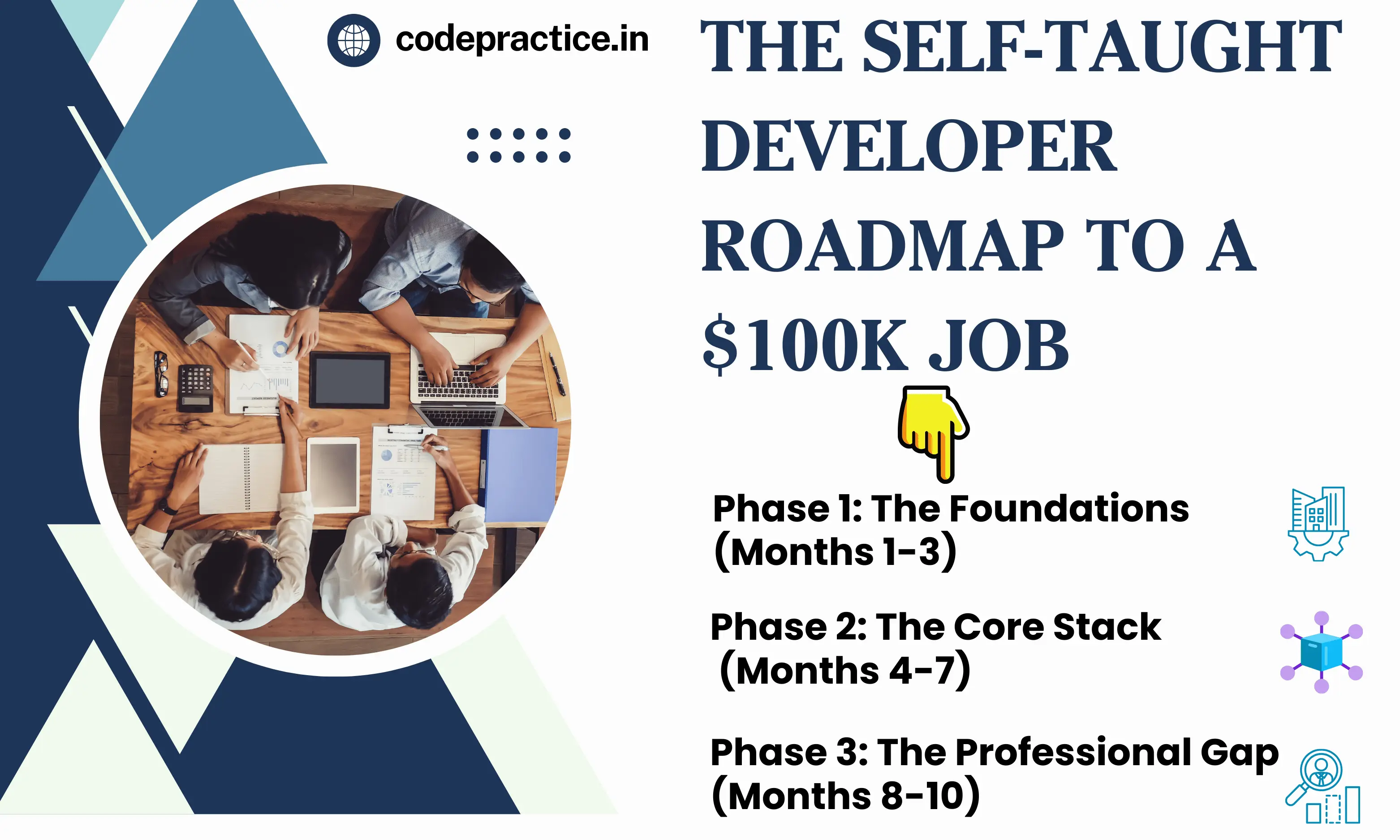
Phase 1: The Foundations (Months 1-3)
Master the fundamentals of logic. If you're doing web dev, that’s HTML, CSS, and deep JavaScript. You should understand the "Event Loop" and "Closures" before you ever touch React. Use Code Practice daily during this phase to make these concepts second nature.
Phase 2: The Core Stack (Months 4-7)
Pick a modern stack (Next.js, TypeScript, and a Backend-as-a-Service like Supabase). Build three small apps that do one thing exceptionally well.
Phase 3: The Professional Gap (Months 8-10)
This is where you learn Git, testing (Jest/Playwright), and CI/CD pipelines. This is what makes you look like a pro, not a student.
Go In-Depth: Coding Practice Roadmap for College Students: Learn Programming Step by Step
7. Technical Pillars: DSA and System Design
I know, I know. You want to build cool apps, not sort binary trees. But the reality of the 2026 market is that technical filters are stricter than ever.
Data Structures and Algorithms (DSA) for Junior Roles
You need a LeetCode roadmap for job seekers. But don't try to solve 500 problems. Focus on the "Patterns." There are about 12 core patterns (Sliding Window, Two Pointers, DFS/BFS) that cover 90% of interview questions. When you study data structures and algorithms for junior roles, your goal is to show you can think efficiently.
System Design for Entry-Level Developers
Two years ago, juniors didn't need to know system design. Today, they do. Why? Because AI can write the functions, but it still struggles with the "Big Picture" architecture. You should be able to explain:
-
The Client-Server Model: What happens when a user types a URL?
-
Databases: Why choose SQL over NoSQL for a specific use case?
-
Scaling: How would you handle 10,000 users hitting your app at the same time?
8. Portfolio Projects That Guarantee a Job
Stop building Todo Lists. Stop building Weather Apps. I have seen a thousand of them, and I've stopped looking at them.
To create portfolio projects that guarantee a job, you need to solve a real, boring, messy problem.
-
Example: A dashboard for a local non-profit to manage their volunteer hours.
-
Example: A customized inventory system for a small e-commerce brand.
The "Magic Sauce" of a project isn't how pretty it is; it’s the README file. I want to read about the "Trade-offs." Tell me: "I wanted to use Redux, but I realized Context API was enough for this scale, so I switched to keep the bundle size small." That sentence alone tells me you are a real engineer.
Also Read: How to Learn Coding from Scratch in 2026 (Step-by-Step Guide)
9. When to Start Applying for Developer Jobs
Most people wait far too long. They wait until they feel "ready."
Here is a secret: You will never feel ready. The time for when to start applying for developer jobs is when you can:
-
Explain how a basic web app works from end-to-end.
-
Solve a "Medium" difficulty algorithm problem on your own.
-
Have one "Deep" project live on the web that you can talk about for 15 minutes.
Start applying the moment you hit these three marks. Every rejection is just "free market research" telling you what to study next.
10. The 2026 Interview Game: STAR Method and Best Tools
Landing the interview is only half the battle. You have to close the deal.
-
Behavioral Interview Tips for Engineers (STAR Method): We don't hire "lone wolves." We hire teammates. Use the STAR method (Situation, Task, Action, Result) for every non-technical question.
-
The Tools: Use the best coding interview practice tools 2026. Of course, Code Practice is your home for syntax and logic, but you should also supplement with platforms like Pramp for mock interviews to practice talking while you code.
Closing Thoughts: It’s a Marathon, Not a Sprint
Learning to code is hard. It’s supposed to be hard. If it were easy, it wouldn't pay what it does.
How many hours of coding practice to get a job? Enough until you stop fearing the blank screen. Enough until you stop seeing an "Error 404" as a failure and start seeing it as a clue.
The market in 2026 isn't looking for geniuses. It’s looking for people who show up, put in the reps on Code Practice, and refuse to quit when the console log turns red.
You’ve got this. Now, go open your editor—or better yet, jump onto Code Practice—and start your first session of the day.
Frequently Asked Questions (FAQs)
Q1: Is 1 hour of coding practice a day enough to get a job?
While practicing for one hour a day is better than nothing, it is usually not enough to reach job readiness within a year. For a beginner to reach a professional level, you need approximately 1,000 hours of focused effort. At one hour a day, this would take nearly three years. To land a job in 6–12 months, you should aim for 3 to 4 hours of active coding per day. Using platforms like CodePractice can help make these hours more efficient by focusing on high-impact muscle memory drills rather than passive watching.
Q2: How can I get a coding job without a degree in 2026?
In the current market, your "Proof of Work" is your degree. To get hired, you need a high-quality GitHub portfolio featuring at least two unique, real-world projects—not just tutorial clones. Companies in 2026 prioritize candidates who can demonstrate problem-solving skills and a mastery of the modern tech stack. Proving your consistency through daily streaks on CodePractice and contributing to open-source projects are the best ways to stand out to recruiters.
Q3: What is the fastest way to escape "Tutorial Hell"?
The fastest way to escape tutorial hell is to follow the 20/80 Rule: spend 20% of your time learning and 80% of your time building. The moment you finish a tutorial module, go to CodePractice to drill the logic you just learned without looking at the instructions. Building "unassisted" is the only way to move from understanding code to actually being able to write it from scratch.
Q4: Which coding skills are most in-demand for junior developers right now?
Beyond knowing a specific language like JavaScript or Python, juniors in 2026 must be proficient in AI-assisted development, version control (Git), and basic System Design. Understanding how to integrate APIs and manage databases is crucial. Most importantly, recruiters look for "Deep Foundations"—a strong grasp of Data Structures and Algorithms, which you can master through consistent daily drills.
Q5: How do I prepare for technical interviews with no prior experience?
Preparation should be two-fold: Technical and Behavioral. Technically, you should master the top 15-20 coding patterns (like Sliding Window or Two Pointers) using CodePractice. Behaviorally, you must practice the STAR method to explain your past projects and challenges. Most rejections happen because the candidate cannot explain their thought process, so practice "thinking out loud" while you code.
Related Tags:
AI-assisted coding practice
how to escape tutorial hell 2026
coding practice schedule for beginners
self-taught developer roadmap 2026
system design for junior developers
data structures and algorithms patterns
best coding interview practice tools
behavioral interview STAR method
full-stack developer skills 2026
prompt engineering for developers
job-ready coding projects
coding bootcamp vs self-taught
front-end developer roadmap 2026
back-end engineering fundamentals
professional portfolio for developers

Hi, I'm Bikki Singh — Full Stack Developer, coding language trainer, and founder of CodePractice.in. With 5+ years of hands-on web development experience, I've trained 500+ students across India in Python, PHP, Java, C, C++, MySQL, and front-end technologies like HTML, CSS, and JavaScript. I started CodePractice.in with one goal: make programming education practical, not theoretical. Every tutorial and blog I write is built around real projects and interview scenarios — so learners don't just understand code, they can actually use it.


Read Coding Blogs on Different Topics
Learn Our Free Tutorials on

Submit Your Reviews