-
Hajipur, Bihar, 844101
Why Python Is Best Language for Beginners in 2026: A Mentor's Guide

Published By
Bikki SinghSo, you’ve decided to learn how to code. First of all, take a deep breath. You’re making a choice that will likely change your life. I’ve been in the tech industry for years, and I’ve seen languages come and go. I’ve seen "hype trains" crash and burn. But through all that volatility, one name has remained constant, growing stronger every single year: Python.
If you’re asking yourself, "Why learn Python in 2026?" when there are flashy new tools everywhere, you’re asking the right question. You don't want to waste six months on a dying technology. As your mentor, I’m here to tell you that Python isn't just a safe bet—it is the best bet for anyone starting from zero.
In this blog, we aren't just going to look at code snippets. We’re going to look at the "why" behind the "what." We’re going to talk about the job market, the psychological hurdles of learning, and why Python is the only language that feels like it’s actually on your side.
The Psychology of Coding: Why Most Beginners Quit
Before we talk about variables and loops, we need to talk about why people fail. Most beginners quit coding because of cognitive overload. They pick a language like C++ or Java, and within three days, they are staring at complex memory management errors or "public static void main" repetitive setup code that makes no sense to a human being.
This is the first reason why Python is best language for beginners. It respects your mental energy.
Python was designed with a specific philosophy: Readability counts. It was built to be read by humans first and machines second. When you look at Python code, your brain doesn't have to work overtime to translate symbols into meaning.
For example, if you want to check if a name is in a list, in Python you literally write:
if "Rahul" in student_list:
It’s intuitive. It’s logical. This Python simple syntax keeps your dopamine levels high because you’re actually making progress instead of fighting with the keyboard. Unlike other easy to learn coding languages, Python doesn't sacrifice power for simplicity.
Go In-Depth: Why Most Beginners Fail in Coding (And How to Avoid It)
Python vs Java for Beginners: A 2026 Reality Check
I often hear students say, "But my uncle told me I should learn Java because big banks use it." While your uncle isn't wrong about banks, he might be out of touch with how people learn today.
Let’s do a quick Python vs Java for beginners comparison:
-
The "Boilerplate" Wall: In Java, to simply print text to a screen, you need to understand classes, methods, and access modifiers from day one. That’s like learning how an internal combustion engine works before you’re allowed to turn the steering wheel.
-
The Flexibility Factor: Python is a high-level programming language. This means you don't have to tell the computer that a number is an integer every single time. Python is smart enough to figure it out. Java is "stricter." For a professional architect, strict is good. For a beginner trying to build their first house, strict is a nightmare.
In 2026, the industry has shifted. Even the "big banks" are moving their data science and AI wings to Python. Why? Because Python allows for faster prototyping. In the business world, speed is money.
Go In-Depth: Python vs Java: Which is Better for Beginners?
The "AI Revolution" and Your Career
We cannot talk about 2026 without talking about Artificial Intelligence. You’ve seen the tools, you’ve seen the automation. Some people are scared that AI will replace programmers.
As a mentor, I see it differently: AI is making Python programmers more valuable than ever.
Python is the "lingua franca" of AI. Whether it’s Large Language Models (LLMs), computer vision, or predictive analytics, the libraries used are almost exclusively Python-based. When you learn Python, you aren't just learning to "code"; you are learning the control panel for the most powerful technology humanity has ever created.
If you’re worried about how to navigate this path, don’t just wing it. You need a structured plan that takes you from "I don't know what a variable is" to "I am getting interviewed by tech firms." I’ve laid out the entire journey here: Python Roadmap for Beginners to Job Ready (2026). Trust me, having a map makes the mountain much easier to climb.
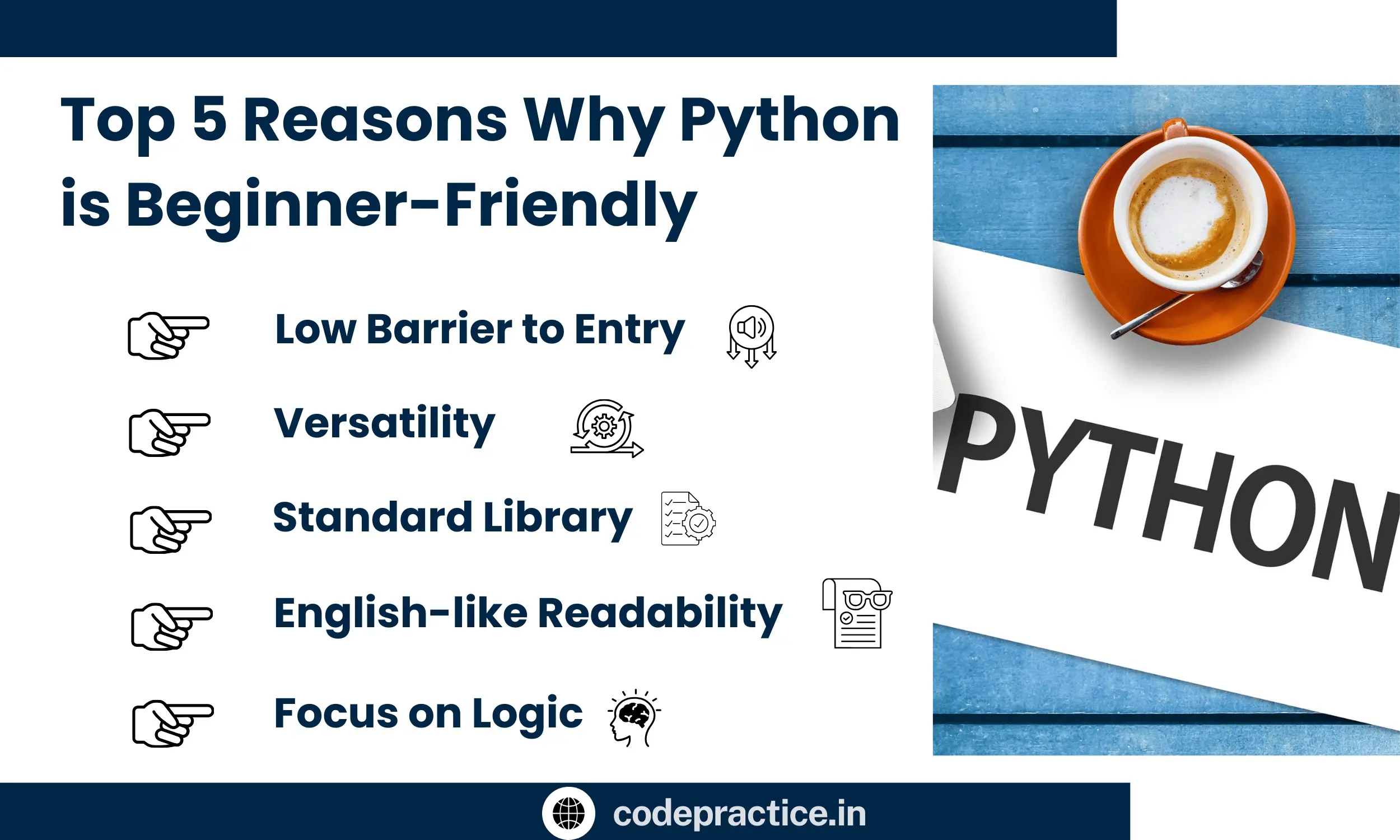
Top 5 Reasons Why Python is Beginner-Friendly
If I had to summarize the benefits of Python programming for someone starting today, it would come down to these five pillars:
-
Low Barrier to Entry: You can install it and write your first program in under 5 minutes.
-
Versatility: You can use it for web dev, data analysis, AI, and even game development.
-
Standard Library: It comes "batteries included," meaning it has built-in tools for almost everything.
-
English-like Readability: It feels more like writing a recipe than writing a complex math formula.
-
Focus on Logic: It allows you to learn how to solve problems, which is the most important skill in software engineering.
The Ecosystem: Why You’ll Never Be "Stuck"
Imagine you’re building a Lego set, but you realize you’re missing a piece. In some languages, you have to manufacture that piece yourself from raw plastic. In Python, someone has already built the piece for you and left it on your doorstep for free.
These are called Python libraries for beginners.
-
Pandas & NumPy: These are the gold standards for anyone entering Data Science. They allow you to handle millions of rows of data as easily as an Excel sheet.
-
Django & Flask: If you want to build the next big web app, these frameworks have the blueprints ready.
-
BeautifulSoup: Perfect for web scraping and data collection.
The benefits of Python programming extend far beyond the language itself. It’s the millions of pre-written modules that allow you to stand on the shoulders of giants. This is why Python is the best programming language for beginners—it allows you to achieve "pro-level" results while you’re still a student.
Also Read: Daily Coding Practice Routine for Beginners That Actually Works in 2026
Python Career Opportunities: Is the Market Oversaturated?
This is a common fear. "Everyone is learning Python, will I find a job?"
The answer is a resounding yes, but with a catch. You won't find a job just by knowing "Python syntax." You find a job by using Python to solve specific problems. In 2026, Python career opportunities have branched into several high-paying niches:
-
Data Engineering: Companies have more data than they know what to do with. They need people to build the "pipelines" using Python.
-
DevOps & Cloud: If you want to work with AWS or Azure, Python is the primary language for writing scripts that manage thousands of servers.
-
Cybersecurity: Hackers use Python, and the people catching them use Python too. It’s the gold standard for security scripting.
Go In-Depth: How Much Coding Practice Is Enough to Get a Job? The 2026 Roadmap to Mastery
Why is Python Preferred Over C++ for First-Time Coders?
Some "hardcore" programmers argue that Python is too easy and that it "spoils" beginners. They say you should learn C++ first so you understand how memory works.
Let me give you an analogy. Do you need to learn how to forge steel and vulcanize rubber before you learn how to drive a car? No. You learn to drive first so you can get where you need to go. Once you are a great driver, if you want to become a mechanic, you can learn about the engine later.
Why is Python preferred over C++ for your first step? Because C++ forces you to manage memory, deal with pointers, and handle complex headers. Python lets you focus on the solution. Once you understand logic, loops, and data structures in Python, you can learn any other language in a fraction of the time.
Python Community Support: You Are Not Alone
The Python community support is, quite frankly, legendary. In 2026, this community has grown to include millions of developers across the globe.
If you encounter a bug at 2 AM, chances are someone in a different time zone has already posted the solution on a forum. As a beginner, this is your safety net. You aren't just learning a tool; you are joining a global club of problem solvers. From local "PyCon" meetups to massive Discord servers, the help is always there if you ask for it.
Python Projects for Beginners with Source Code
To truly learn, you need to build. I always suggest starting with these small Python projects for beginners with source code (which you can find easily on GitHub):
-
Automated Email Sender: Learn how to connect Python to Gmail.
-
Currency Converter: Use an API to get real-time exchange rates.
-
Personal Finance Tracker: Use Pandas to analyze your monthly spending.
-
Desktop Assistant: A mini-version of Alexa that responds to your voice commands.
Building these projects is the fastest way to answer the question: How long does it take to learn Python for a beginner? If you build one project a week, you will be proficient in 3 months.
Conclusion: Your Journey Starts Now
As your mentor, my final piece of advice is this: Don't wait for the "perfect" time. The tech landscape of 2026 is moving faster than ever. The difference between someone who is a "coder" and someone who just "wants to code" is one thing: Execution.
Python is the best language to start with because it has the lowest barrier to entry and the highest ceiling for growth. It is simple enough to learn in a month, but deep enough to spend a lifetime mastering.
Go ahead and take that first step. Install Python, write your first print statement, and follow the Python Roadmap for Beginners to Job Ready (2026) to stay on track.
The world needs more problem solvers. It’s time you became one of them.
Frequently Asked Questions (FAQs)
Q1: Is Python still the best language for beginners in 2026?
Yes, Python remains the no. 1 choice for beginners in 2026. Its English-like syntax and massive popularity in AI, Machine Learning, and Data Science ensure that it is not only easy to learn but also highly relevant for the modern job market.
Q2: How long does it take for a beginner to learn Python?
For a complete beginner, it typically takes 4 to 8 weeks to master the basics of Python (variables, loops, and functions). However, to become job-ready and build real-world projects, most learners require 6 to 9 months of consistent practice.
Q3: Why is Python preferred over C++ or Java for first-time coders?
Python is preferred because it is a high-level language with a simple syntax that avoids complex repetitive setup code. Unlike C++ (which requires manual memory management) or Java (which is very "wordy"), Python allows beginners to focus on problem-solving logic rather than complicated language rules.
Q4: Can I get a job just by learning Python in 2026?
While Python is a powerful foundation, most employers look for specific specializations. Python developers are in high demand for roles in Data Analytics, AI Engineering, Backend Development (Django/FastAPI), and Automation. To be competitive, it is recommended to follow a structured Python Roadmap.
Q5: With the rise of AI tools like ChatGPT and GitHub Copilot, is it still worth learning Python in 2026?
Absolutely. While AI can write snippets of code, it cannot solve complex business problems or architect a full system. Learning Python in 2026 is actually more valuable because AI tools act as "force multipliers" for those who understand the language. Instead of replacing you, AI helps a Python developer work 10x faster. You still need Python knowledge to prompt correctly, debug AI-generated code, and integrate AI models into real-world applications.
Related Tags:
Python for beginners 2026
Why learn Python in 2026
Best programming language for beginners
Python vs Java for beginners
Benefits of Python programming
Python simple syntax
Python career opportunities
Easy to learn coding languages
Python libraries for beginners (Pandas
NumPy)
Python community support
High-level programming language
Hi, I'm Bikki Singh — Full Stack Developer, coding language trainer, and founder of CodePractice.in. With 5+ years of hands-on web development experience, I've trained 500+ students across India in Python, PHP, Java, C, C++, MySQL, and front-end technologies like HTML, CSS, and JavaScript. I started CodePractice.in with one goal: make programming education practical, not theoretical. Every tutorial and blog I write is built around real projects and interview scenarios — so learners don't just understand code, they can actually use it.


Read Coding Blogs on Different Topics
Learn Our Free Tutorials on

Submit Your Reviews