-
Hajipur, Bihar, 844101

Placement Preparation Roadmap 2026: How to Crack Your Dream Job in Final Year

Published By
Bikki SinghListen, I know exactly what is going through your mind right now. You are in your final year, the pressure from parents is mounting, your friends are posting "placed" stories on LinkedIn, and you are sitting there wondering if your skills are enough to survive the cut-throat competition.
As a mentor who has seen thousands of students navigate this "placement season" chaos, let me tell you one thing clearly: Getting placed is not about being the smartest person in the room; it is about having the best strategy. You don't need to know everything; you just need to know what the recruiters are looking for in 2026.
In this comprehensive guide, I am giving you the exact Placement Preparation Roadmap for Final Year Students that I give to my personal mentees. This is a in-depth article into the technical, mental, and professional shifts you need to make to land that offer letter.
Why 2026 is a Game Changer for Campus Placements
The hiring landscape has shifted dramatically over the last couple of years. The era of "mass hiring" where companies would take anyone with a basic degree is fading. Today, companies want "Day 1 Ready" engineers. With the rise of AI-assisted coding and automated workflows, recruiters are no longer impressed by someone who can just write a "Hello World" program.
They are looking for people who understand the "Why" behind the "How." They want students who have solid core fundamentals, can navigate complex Data Structures, and have the grit to solve real-world problems. Whether you are targeting On-campus vs Off-campus placement, your preparation must be bulletproof.
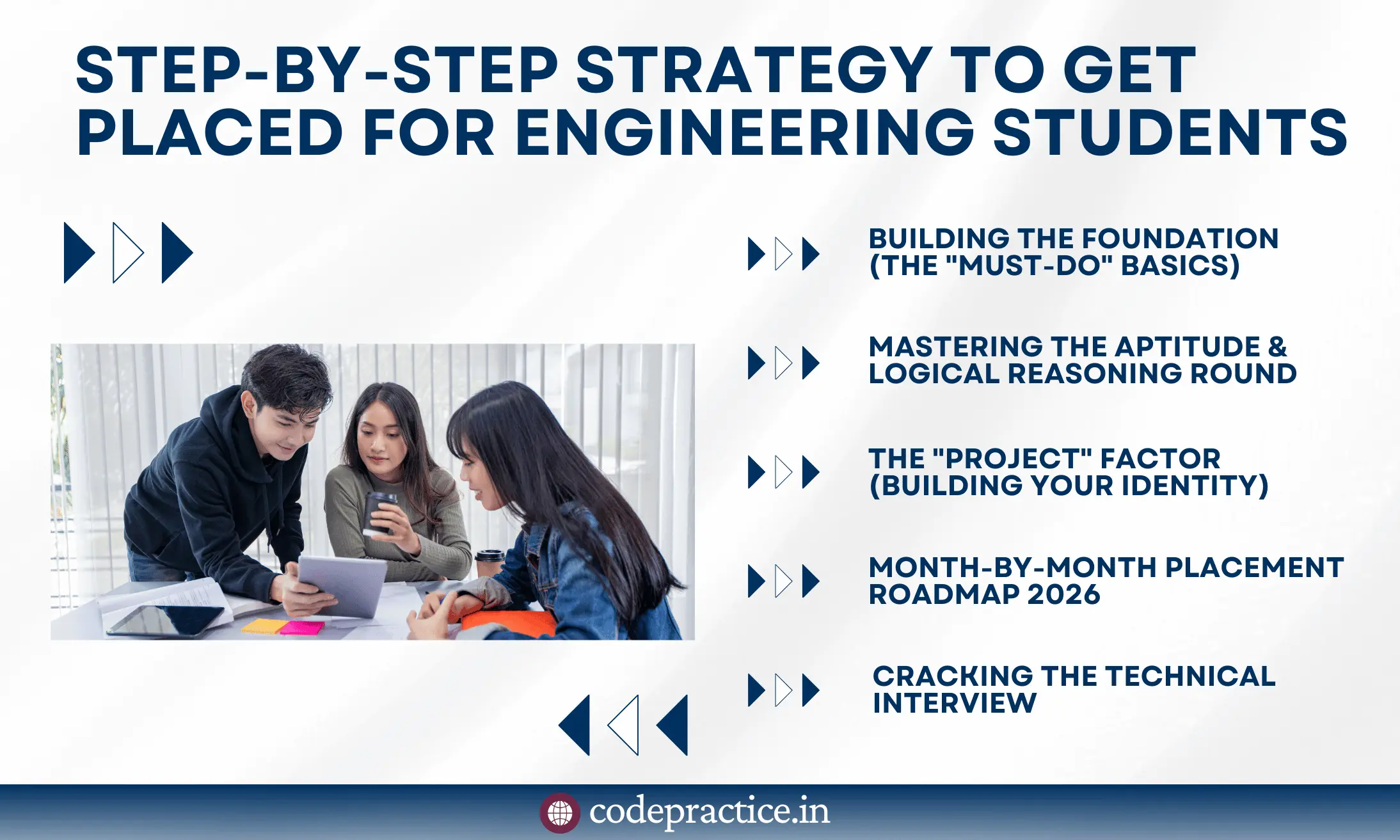
Step 1: Building the Foundation (The "Must-Do" Basics)
Before you jump into complex coding or high-level system design, you need to fix your basics. If your foundation is weak, you will fail the initial screening tests, no matter how good your communication skills are.
1. Master One Programming Language (The Depth Over Breadth Rule)
The biggest mistake I see final year students making is trying to learn five languages at once. They know a bit of C, a bit of Java, and a bit of Python. In an interview, this is a recipe for disaster.
Pick one language and master it to its core. If you are choosing Python because of its massive demand in AI, Data Science, and Backend Development, make sure you follow a structured Python Roadmap for Beginners to Job Ready (2026).
Why Python? Because in 2026, the speed of development matters. However, "knowing" Python isn't just about syntax. You need to understand memory management, decorators, generators, and how it handles asynchronous tasks. If you are just starting out, don't skip the basics; go through a proper Python Tutorial to ensure you aren't building your house on sand.
2. Data Structures and Algorithms (DSA): The Great Filter
This is the heart of your Software Developer (SDE) Placement Roadmap. You cannot escape this. Whether it is a service-based company like TCS or a product giant like Google, they will test your problem-solving skills through DSA.
-
The Beginner Phase: Start with Arrays, Strings, Linked Lists, Stacks, and Queues. Understand how they are stored in memory.
-
The Intermediate Phase: Move to Recursion, Searching, and Sorting. Most students struggle with Recursion, but it is the key to understanding advanced topics.
-
The Pro Phase: This is where the big packages are won. Master Trees, Graphs, and Dynamic Programming (DP).
-
The Strategy: Don't just watch videos. Solve problems. Aim for at least 250 questions on coding platforms. Focus on "Must-do DSA questions for top product companies" to maximize your efficiency.
Step 2: Mastering the Aptitude & Logical Reasoning Round
I have seen brilliant coders fail to get into top companies because they couldn't clear the first round: The Aptitude Test. Companies like TCS, Wipro, and Infosys use these tests to filter out the crowd.
Quantitative Aptitude for Placements includes:
-
Arithmetic: Profit & Loss, Time & Work, Percentages, and Averages.
-
Algebra & Geometry: Basic formulas that you probably forgot after 10th grade.
-
Logical Reasoning: This tests your "brain wiring." Focus on Syllogisms, Blood Relations, Seating Arrangements, and Coding-Decoding.
Pro Tip: Treat Aptitude like a daily workout. Spend 45 minutes every morning solving 15-20 questions. It builds the mental speed you need during the actual exam where you have less than a minute per question.
Step 3: The "Project" Factor (Building Your Identity)
Your resume is your ticket to the interview, and your projects are the engine of that resume. If your resume only has "College Management System" or "Weather App," you are blending into the crowd. To rank high in the recruiter's mind, you need projects that solve a problem or demonstrate high technical competence.
For those focusing on Python, don't just do basic scripts. Aim for something substantial. You can find inspiration here: Python Projects Ideas for College Students 2026: Expert Guide.
Whether it is a Machine Learning model, a Web Scraper that provides value, or a Backend API using FastAPI, ensure you have:
-
A clean GitHub repository with a proper README.
-
The ability to explain every single line of code you wrote.
-
A live demo or a video showing the project in action.
A Word of Caution: While building these projects, students often pick up bad habits from outdated tutorials. If you want to look like a professional, avoid the "beginner traps." Read this guide on 15 Common Python Mistakes Beginners Must Avoid. Using the right variable names and handling exceptions properly can be the difference between a "Selected" and a "Rejected" status.
Step 4: Month-by-Month Placement Roadmap 2026
If you are starting today, here is your tactical timeline:
Month 1: The Language In-depth
Spend this month mastering your chosen language. If it is Python, go through the Python Tutorial and start solving basic "Strings and Arrays" problems. Start your aptitude practice now—don't wait for the last month.
Month 2: The DSA Grind (Part 1)
Focus on Linear Data Structures. Implement everything from scratch. Don't just use built-in libraries; write the logic for a Linked List or a Stack yourself. This is also the time to start learning SQL.
Month 3: The DSA Grind (Part 2) & Core Subjects
Move to Non-linear Data Structures like Trees and Graphs. This is the hardest part of the Placement Preparation Roadmap. Simultaneously, start reading one core subject per week (OS, then DBMS, then CN).
Month 4: The Build Phase
Start working on your major projects. This is where you apply your knowledge. If you're building with Python, refer back to the Python Projects Ideas for College Students 2026 to ensure your project is "industry-grade."
Month 5: Resume & Mock Interviews
Draft your resume. Keep it to one page. Start giving mock interviews with friends or seniors. Focus on your "Introduction" and your "Project Explanation." You should be able to explain your project to a 5-year-old and a CTO.
Month 6: Company Specific & Revision
If you have a TCS NQT coming up, solve their previous year papers. If you are aiming for the Amazon SDE Interview, focus on their Leadership Principles and hard-level DSA. Review the Must-Know Python Interview Questions with Practical Answers for 2026 to polish your technical answers.
Step 5: Cracking the Technical Interview
You can be the best coder in the world, but if you cannot communicate your thoughts, you won't get the job. The "Personal Interview" or "HR Round" is where the company checks if you are a "culture fit."
-
The "Tell Me About Yourself" Pitch: This is not a summary of your resume. It is a story of your journey, your passion for tech, and why you are sitting in that chair today.
-
The STAR Method: When asked about challenges or teamwork, use the Situation, Task, Action, and Result (STAR) method. It keeps your answers structured and professional.
-
Active Voice in Interviews: Instead of saying "The project was completed by my team," say "I led the team to complete the project 2 days before the deadline." Own your achievements.
The Core Engineering Pillars
If you are an engineering student, your technical interview won't stop at coding. You will be grilled on the subjects you supposedly studied for three years. These are the "Core Four":
-
Operating Systems (OS): You must understand Process Scheduling, Deadlocks, Paging, and Segmentation. If you can't explain the difference between a Process and a Thread, you aren't ready for an SDE-1 role.
-
Database Management Systems (DBMS): SQL is a non-negotiable skill. You should be able to write complex Joins on a whiteboard. Understand Normalization, ACID properties, and the difference between SQL and NoSQL.
-
Computer Networks (CN): Focus on the OSI Model, TCP/IP vs UDP, and how the DNS works. In the world of cloud computing, networking knowledge is more valuable than ever.
-
Object-Oriented Programming (OOPS): This is the favorite topic of interviewers. You must be able to explain Abstraction, Encapsulation, Inheritance, and Polymorphism with real-world examples—not just textbook definitions.
Off-Campus vs On-Campus: The Strategy
In 2026, you cannot rely solely on your college placement cell.
-
On-Campus: Your main goal is to be in the top 10% of your batch. The company is already at your door; you just need to not give them a reason to reject you.
-
Off-Campus: This is a different beast. You need to create a network on LinkedIn, find HR emails, and most importantly, get Referrals. A referral bypasses the automated resume scanners (ATS) and puts your resume directly on the hiring manager's desk.
Final Mentor Advice: Don't Panic, Just Prepare
The journey from a "Final Year Student" to a "Placed Professional" is a marathon, not a sprint. There will be weeks where you feel like you've forgotten everything. There will be rejection emails that make you question your worth.
But remember: Every "No" is just practice for the "Yes" that matters.
Stick to this Placement Preparation Roadmap 2026. Master your language, grind the DSA, build projects that actually work, and keep your core fundamentals sharp. If you follow this plan with discipline, you won't just get a job—you will start a career.
Now, enough reading. Close this tab, open your IDE, and write your first line of code for the day. Your future self will thank you for the work you put in today.
Quick Recap of Your Next Steps:
-
Check the Python Roadmap to align your learning path.
-
Start the Python Tutorial if you're rusty on basics.
-
Pick a project from the Project Guide.
-
Brush up on Interview Questions to stay ahead of the curve.
Good luck, you've got this!
Frequently Asked Questions (FAQs)
Q1: When should I start my placement preparation for 2026?
The ideal time to start is at least 6 to 8 months before the placement season begins. For the 2026 batch, starting in the summer of 2025 allows you to master DSA, complete industry-level projects, and revise core CS subjects without the last-minute panic of exam schedules.
Q2: Which programming language is best for campus placements in 2026?
While C++ and Java are traditionally preferred for their speed and standard libraries (STL/Collections), Python has become a top choice in 2026 due to its dominance in AI and Data Science. Pick one language and master its advanced concepts rather than learning multiple languages superficially.
Q3: Are internships mandatory for getting placed in top tech companies?
While not strictly mandatory, internships provide a massive competitive edge. They demonstrate real-world experience and professional ethics. If you lack an internship, compensate by building high-quality, deployed open-source projects that showcase your ability to write production-ready code and work with modern tech stacks.
Q4: How many DSA questions should I solve to crack product-based companies?
Quality matters more than quantity, but a benchmark of 250 to 300 well-chosen problems is recommended. Focus on "Must-do" lists covering Arrays, Strings, Trees, Graphs, and Dynamic Programming. Ensure you can explain the time and space complexity for every solution you write.
Q5: What are the most important subjects for technical interviews?
Apart from coding, you must master Operating Systems (OS), Database Management Systems (DBMS), Computer Networks (CN), and Object-Oriented Programming (OOPS). In 2026, many companies also ask basic questions on System Design and Cloud Computing fundamentals even for fresher roles.
Related Tags:
Placement Preparation Roadmap 2026
SDE Roadmap for Final Year Students
Crack Campus Placements in 6 Months
DSA Roadmap for Product Based Companies
TCS NQT vs Off-Campus Placement Strategy
Must-Know Aptitude and Coding Topics 2026
Final Year Project Ideas for Job Ready Resume
How to Prepare for HR and Technical Interviews
Python for Placements Job Ready Guide
Resume Building Tips for Freshers 2026


Hi, I'm Bikki Singh — Full Stack Developer, coding language trainer, and founder of CodePractice.in. With 5+ years of hands-on web development experience, I've trained 500+ students across India in Python, PHP, Java, C, C++, MySQL, and front-end technologies like HTML, CSS, and JavaScript. I started CodePractice.in with one goal: make programming education practical, not theoretical. Every tutorial and blog I write is built around real projects and interview scenarios — so learners don't just understand code, they can actually use it.


Read Coding Blogs on Different Topics
Learn Our Free Tutorials on

Submit Your Reviews