-
Hajipur, Bihar, 844101
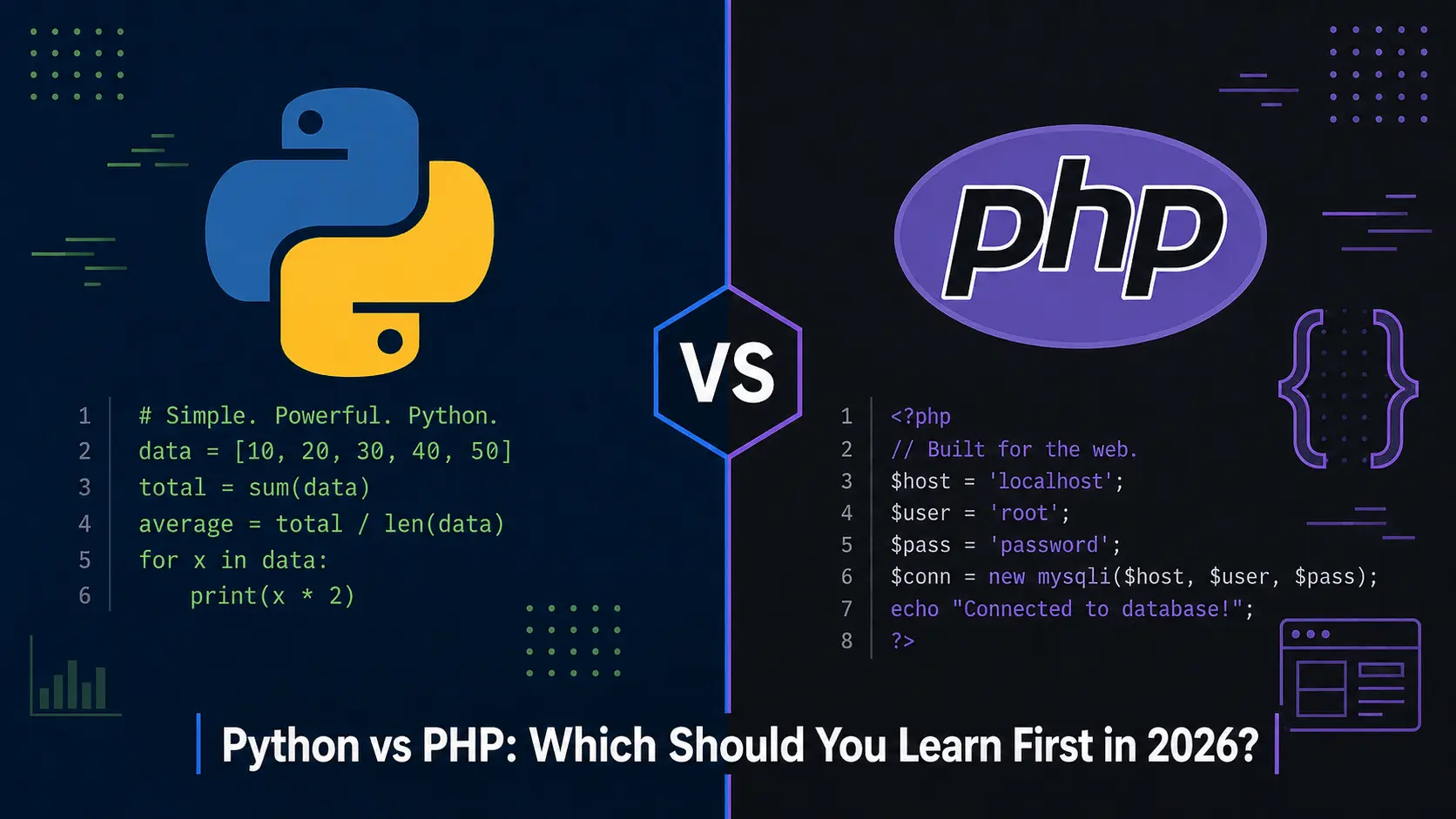
Python vs PHP: Which Should You Learn First in 2026?

Published By
Bikki SinghTL;DR: If you're starting from zero in 2026, learn Python first. It's easier to read, has more job opportunities, and opens doors to web dev, data science, and AI — not just websites. PHP is still worth learning, but only if WordPress or Laravel is your specific goal.
You open your laptop, ready to commit to learning your first programming language. You Google around for twenty minutes and end up more confused than when you started. Half the posts say PHP is dead. The other half say Python is overkill for web development. Neither actually answers your question.
So here's the straight answer: Python vs PHP isn't really a close race for most beginners in 2026. But the right choice still depends on what you want to build.
What Is Python?
Python: A general-purpose programming language created by Guido van Rossum in 1991. It's designed to be readable — the syntax is close to plain English. Python is used in web development, data science, machine learning, automation, scripting, and now heavily in AI tooling.
Learn Python with CodePractice - Free Tutorial
What Is PHP?
PHP: A server-side scripting language built specifically for the web. Created in 1994, PHP powers roughly 77% of all websites with a known server-side language [Stat: W3Techs, 2026]. That number is largely because WordPress runs on PHP. If you strip out WordPress, PHP's footprint shrinks fast.
Think of it this way: Python is a Swiss Army knife. PHP is a very well-made kitchen knife — excellent at its specific job, less useful outside that context.
Learn PHP with CodePractice - Free Tutorial
Why Python Wins for Most Beginners in 2026
The first language you learn shapes how you think about programming. Python's syntax makes that foundation clean.
Compare a simple task — print a greeting based on user input — in both languages:
PHP:
<?php
// Read input from command line argument
$name = $argv[1] ?? "stranger";

// PHP requires the echo statement and the closing tag in scripts
echo "Hello, " . $name . "!\n";
?>
Python:
import sys

# sys.argv[1] is the first command-line argument; default to "stranger" if missing
name = sys.argv[1] if len(sys.argv) > 1 else "stranger"

print(f"Hello, {name}!")
Both do the same thing. But notice Python's version reads almost like a sentence. That matters when you're still figuring out what a variable even is.
Python also doesn't require you to manage opening and closing tags (<?php ... ?>), doesn't use $ for every variable name, and doesn't mix HTML and logic in the same file by default. These aren't dealbreakers — but they remove friction when you're just starting.
[Stats: According to the Stack Overflow Developer Survey 2025, Python ranked as the most-used programming language for the third year in a row among all developers, while PHP ranked 8th.]
When PHP Actually Makes More Sense
Don't dismiss PHP. It's not legacy junk — PHP 8.4 ships with a JIT compiler, named arguments, fibers, and enums. Laravel is genuinely one of the best web frameworks in any language, not just PHP.
Here's when PHP is the right call:
You want to work with WordPress. WordPress runs 43% of the web [Stats: W3Techs, 2026]. Agencies, freelancers, and small business sites all run on it. If your goal is freelance web income in the next 6 months, PHP gets you there faster.
You're joining a team that's already on Laravel or Symfony. Don't switch stacks to match your first language preference. Match the team.
You're doing server-side rendering for content-heavy sites. PHP was built for request-response cycles. It's fast at that specific pattern.
A minimal Laravel route looks like this:
<?php

use Illuminate\Support\Facades\Route;

// Define a GET route at /hello that returns a greeting
Route::get('/hello/{name}', function (string $name) {
    // Laravel automatically handles routing, request parsing, and response
    return response()->json([
        'message' => "Hello, $name!"
    ]);
});
This is clean, readable, and production-ready. Laravel deserves its reputation.
But for a beginner who doesn't yet know what they want to build? Python gives you more room to grow.
Python vs PHP: Side-by-Side Comparison
| Feature | Python | PHP |
|---|---|---|
| Beginner-friendliness | ✅ Cleaner syntax, easier to read | ⚠️ Doable, but quirkier for beginners |
| Web development | ✅ Django, Flask, FastAPI | ✅ Laravel, Symfony, CodeIgniter |
| Data science / AI / ML | ✅ NumPy, Pandas, TensorFlow, PyTorch | ❌ Not designed for this |
| Job opportunities | ✅ Broad (web, data, DevOps, AI) | ⚠️ Mostly web and CMS work |
| Average US salary | ~$97,000/year | ~$79,500/year |
| Learning curve | Low | Medium (quirks trip beginners up) |
| Freelance income potential | ✅ Strong | ✅ Very strong (WordPress market) |
| Framework quality | Django, FastAPI are excellent | Laravel is excellent |
| Performance (2026) | Closing gap with no-GIL in Python 3.14 | Strong for request-response workloads |
A Real Python Web App in 10 Minutes (Flask)
Here's a working Flask app that handles a GET request and returns JSON. You can run this yourself.
Step 1: Install Flask
pip install flaskStep 2: Write the app
from flask import Flask, jsonify, request

app = Flask(__name__)

# In-memory "database" — fine for learning, use a real DB in production
users = {
    1: {"name": "Ada Lovelace", "role": "developer"},
    2: {"name": "Grace Hopper", "role": "engineer"},
}

@app.route("/users/<int:user_id>", methods=["GET"])
def get_user(user_id):
    # Return 404 if user doesn't exist
    user = users.get(user_id)
    if not user:
        return jsonify({"error": "User not found"}), 404
    return jsonify(user)

if __name__ == "__main__":
    # debug=True reloads the server on file changes — never use in production
    app.run(debug=True)
Step 3: Run it
python app.pyHit http://127.0.0.1:5000/users/1 in your browser and you'll see Ada's data come back as JSON.
What this does: defines two URL routes, handles a missing user with a proper 404, and returns structured JSON — the basics of any real API. The whole thing is 20 lines with comments.
The Gotchas Nobody Warns You About
PHP gotcha: Variable scope in functions
This trips up almost every PHP beginner. Variables defined outside a function are not accessible inside it.
Bad — this doesn't work:
<?php
$site_name = "MyBlog";

function print_header() {
    // $site_name is NOT available here — PHP variable scope doesn't work like JS or Python
    echo "<h1>" . $site_name . "</h1>"; // Undefined variable warning
}

print_header();
?>
Fixed — use global or pass it as an argument:
<?php
$site_name = "MyBlog";

function print_header(string $name) {
    // Better: pass it explicitly rather than relying on global state
    echo "<h1>" . htmlspecialchars($name) . "</h1>";
}

print_header($site_name);
?>
Python gotcha: Mutable default arguments
This one bites beginners and occasionally experienced devs too.
Bad — this will confuse you:
# The list [] is created ONCE when the function is defined, not on each call
def add_task(task, task_list=[]):
    task_list.append(task)
    return task_list

print(add_task("Write tests"))   # ['Write tests']
print(add_task("Fix the bug"))   # ['Write tests', 'Fix the bug'] — not what you expected
Fixed — use None as the default:
def add_task(task, task_list=None):
    # Create a new list on each call if none is provided
    if task_list is None:
        task_list = []
    task_list.append(task)
    return task_list

print(add_task("Write tests"))  # ['Write tests']
print(add_task("Fix the bug"))  # ['Fix the bug'] — correct
What the docs don't make obvious: mutable default arguments in Python are shared across all calls. This pattern (None default + guard clause) is standard practice.
Python vs PHP for Data Science and AI
This section is the whole ballgame for many people.
Python owns this space. Not by a little — by a lot.
If you want to work with data, machine learning, or anything AI-related, PHP is simply not the tool. There's no PHP equivalent of NumPy, Pandas, PyTorch, or TensorFlow. These aren't third-party libraries that happen to exist — they're the foundation of the entire modern AI/ML ecosystem.
A quick example of data work in Python:
import pandas as pd

# Load a CSV of user activity data
df = pd.read_csv("user_activity.csv")

# Filter users who logged in more than 5 times
active_users = df[df["login_count"] > 5]

# Group by country and count
country_breakdown = active_users.groupby("country").size().reset_index(name="active_count")

print(country_breakdown.head())
Five lines. Real data analysis. You can't do this in PHP without significant pain.
Go In-Depth → Numpy Documentation
Go In-Depth → Pandas getting started guide
Wrapping Up
The python vs php question is real, but it's also a bit of a false choice. Both languages work. Both have jobs. Both have good frameworks.
What actually matters: what do you want to build?
If the answer is "something with data, AI, automation, or backend APIs" — Python. If the answer is "WordPress sites, client work, or Laravel apps" — PHP.
For most people reading this with no strong preference either way, Python is the better starting point. It builds transferable skills, has a simpler learning curve in the first few weeks, and opens more career paths.
Pick one. Build something. The switch from one to the other is always easier than the original choice makes it feel.
Your next step: Install Python 3.12+, run through the official Python tutorial, and build one small project — a CLI tool, a simple API, a web scraper. Doesn't matter what. Shipping something beats reading about language comparisons every time.
Also Read → How to set up a Python development environment in 2026
Also Read → Official Python tutorial
Also Read → Laravel documentation
Frequently Asked Questions (FAQs)
Q1: Is PHP still worth learning in 2026?
Yes, absolutely — if your goal is web development, WordPress, or Laravel. PHP powers a massive portion of the web, and Laravel is genuinely a great framework. The problem is that PHP doesn't give you much outside the web lane. If you're choosing your first language and don't have a specific web/WordPress goal, Python gives you more options.
Q2: Which pays more: Python or PHP developer?
Python developers earn roughly $97,000/year median in the US, while PHP developers earn around $79,500/year. The gap exists because Python opens roles in data engineering, ML engineering, and backend AI work — all of which pay premium rates. PHP salaries are solid, especially for senior Laravel or WordPress developers.
Q3: Can I build websites with Python?
Yes. Django is a full-stack web framework comparable to Laravel. FastAPI is the go-to for APIs. Flask is lightweight and great for learning. Python wasn't built exclusively for the web like PHP was, but modern Python web tooling is mature and production-ready.
Q4: What's the difference between Django, Flask, and FastAPI?
Django is "batteries included" — it ships with auth, an ORM, admin panel, and routing out of the box. Flask is minimal; you build what you need. FastAPI is the newest of the three and is optimized for async APIs with automatic documentation. For beginners, Flask is the most approachable. For a full app, Django. For APIs, FastAPI.
Q5: How long does it take to learn Python vs PHP for a beginner?
Both take roughly the same amount of time to reach "I can build something real" level — expect 3–6 months of consistent practice. Python tends to feel more intuitive in the first few weeks because its syntax is closer to plain English. PHP can feel weird early on ($variables, -> arrows, mixed HTML/PHP in templates), but that gets easier fast.
Related Tags:
python vs php
best language for beginners
best language beginner
python vs php for beginners
learn python or php first
python vs php 2026
python vs php web development
php vs python salary
django vs laravel
python for data science beginners
is php still worth learning
php vs python job opportunities
easiest programming language to learn
python beginner friendly
php web development 2026
Hi, I'm Bikki Singh — Full Stack Developer, coding language trainer, and founder of CodePractice.in. With 5+ years of hands-on web development experience, I've trained 500+ students across India in Python, PHP, Java, C, C++, MySQL, and front-end technologies like HTML, CSS, and JavaScript. I started CodePractice.in with one goal: make programming education practical, not theoretical. Every tutorial and blog I write is built around real projects and interview scenarios — so learners don't just understand code, they can actually use it.


Read Coding Blogs on Different Topics
Learn Our Free Tutorials on

Submit Your Reviews