POPULAR
Instant Online HTML Formatter
NEW TOOL
Try our Interactive Python Online Playground!
FEATURED
HTML, CSS & JS Live Code Playground
POPULAR
Try Our Online Code Editor and Compiler
POPULAR
Instant Online HTML Formatter
NEW TOOL
Try our Interactive Python Online Playground!
FEATURED
HTML, CSS & JS Live Code Playground
POPULAR
Try Our Online Code Editor and Compiler
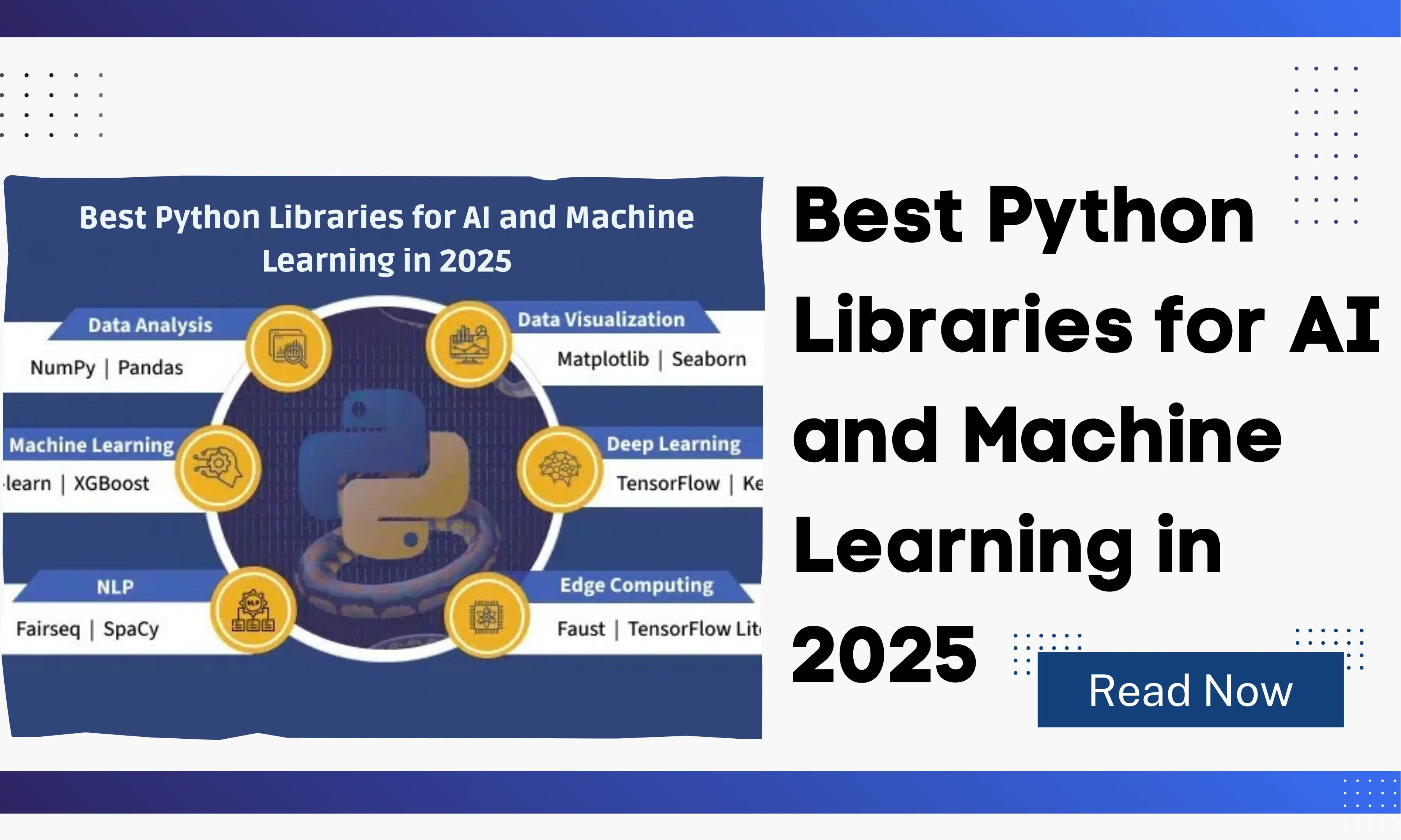
Best Python Libraries for AI and Machine Learning in 2026

Published By
Bikki Singh📑 Table of Contents
- 1. PyTorch 2.x: The Gold Standard for Deep Learning & Foundation Models
- 2. LlamaIndex & LangChain: RAG & Autonomous AI Agent Frameworks
- 3. Hugging Face Transformers & Datasets
- 4. Speech Recognition & Audio AI: OpenAI Whisper & SpeechBrain
- 5. Explainable AI & Model Inspection: SHAP & LIME
- 6. Computer Vision & Image Processing: OpenCV & Albumentations
- 7. Natural Language Processing (NLP): spaCy & NLTK
- 8. Production Model Export & Latency Optimization: ONNX Runtime & TensorRT
- 9. vLLM & Ollama Python Client: High-Throughput Inference Engines
- 10. Scikit-Learn: The Core Foundation for Classical Machine Learning
- 11. TensorFlow & Keras 3.0: Enterprise Machine Learning Pipelines
- 12. Polars & NumPy: High-Performance Data Processing
- 13. Hardware Acceleration: NVIDIA CUDA, Apple MPS, & AMD ROCm
- 14. Summary Matrix: Choosing the Right AI Library in 2026
- Final Advice for AI Developers in 2026
Artificial Intelligence (AI) and Machine Learning (ML) are no longer futuristic concepts reserved for computer science research labs. In 2026, AI is embedded across every modern industry — from natural language user interfaces and autonomous customer support agents to real-time predictive finance, autonomous vehicles, and medical diagnostics.
At the center of this artificial intelligence revolution sits a single programming language: Python. Python's dominance in AI isn't just because of its readable syntax; it is driven by an incredible ecosystem of high-performance open-source AI and Machine Learning libraries built on top of optimized C++, CUDA, and Rust execution engines.
Explore related trends in our Top 10 Python Trends in 2026 and compare learning paths with our Python vs Java Comparison Guide.
In this comprehensive mentor guide, we will break down the top Python libraries for AI and Machine Learning in 2026, complete with real working code examples, hardware acceleration notes, speech recognition tools, explainable AI packages, key features, and practical use cases.
1. PyTorch 2.x: The Gold Standard for Deep Learning & Foundation Models
In 2026, PyTorch (maintained by the Linux Foundation and Meta) is the undisputed industry leader for deep learning research and production model deployment. PyTorch 2.x introduced torch.compile(), which automatically compiles PyTorch Python code into optimized Triton CUDA kernels, delivering massive speedups without changing model architecture code.
# PyTorch 2.x Tensor Operations and Automatic Model Compilation
import torch
import torch.nn as nn

# Checking GPU CUDA acceleration in 2026
device = "cuda" if torch.cuda.is_available() else "cpu"
print(f"⚡ PyTorch 2.x running on compute device: {device}")

# Define a simple Neural Network
class MultiLayerPerceptron(nn.Module):
    def __init__(self):
        super().__init__()
        self.fc1 = nn.Linear(784, 256)
        self.relu = nn.ReLU()
        self.fc2 = nn.Linear(256, 10)

    def forward(self, x):
        return self.fc2(self.relu(self.fc1(x)))

model = MultiLayerPerceptron().to(device)

# PyTorch 2.x TorchCompile for JIT CUDA Kernel Acceleration
optimized_model = torch.compile(model)
print("✅ PyTorch Model successfully compiled with torch.compile()!")
2. LlamaIndex & LangChain: RAG & Autonomous AI Agent Frameworks
Building generative AI tools in 2026 requires connecting Large Language Models to private company data (PDFs, SQL databases, Notion docs). LlamaIndex and LangChain are the leading Python frameworks for Retrieval-Augmented Generation (RAG) and Autonomous Multi-Agent orchestration.
# Production Retrieval-Augmented Generation (RAG) using LlamaIndex
from llama_index.core import VectorStoreIndex, SimpleDirectoryReader

def run_private_ai_query(docs_folder: str, question: str):
    """Loads internal company documents and queries vector embeddings."""
    print("📂 Ingesting company documents...")
    documents = SimpleDirectoryReader(docs_folder).load_data()

    # Building vector index with automatic embeddings
    index = VectorStoreIndex.from_documents(documents)

    # Query engine retrieving context for LLM
    query_engine = index.as_query_engine(similarity_top_k=3)
    response = query_engine.query(question)
    return response
3. Hugging Face Transformers & Datasets
The Hugging Face Transformers ecosystem is the GitHub of AI models. The transformers Python library allows developers to load, fine-tune, and run state-of-the-art pretrained vision, audio, and language models (like LLaMA 3, Mistral, and Whisper) with just a few lines of code.
# Sentiment Analysis Pipeline using Hugging Face Transformers
from transformers import pipeline

# Load pre-trained NLP pipeline in 2 lines of Python
classifier = pipeline("sentiment-analysis", model="distilbert-base-uncased-finetuned-sst-2-english")

reviews = [
    "CodePractice tutorials are extremely clear and helpful for beginners!",
    "The video was way too fast and missing code examples."
]

results = classifier(reviews)
for review, result in zip(reviews, results):
    print(f"Review: '{review}' | Sentiment: {result['label']} (Confidence: {result['score']:.2%})")
4. Speech Recognition & Audio AI: OpenAI Whisper & SpeechBrain
Voice-driven interfaces and automated video transcription rely heavily on OpenAI Whisper and SpeechBrain. Whisper provides near-human accuracy across dozens of languages for transcribing audio files directly in Python.
# Audio Transcription using OpenAI Whisper in Python
import whisper

def transcribe_audio_file(audio_path: str):
    """Transcribes MP3/WAV audio files into text using Whisper."""
    model = whisper.load_model("base")
    result = model.transcribe(audio_path)
    print("📝 Transcription Result:")
    print(result["text"])
    return result["text"]
5. Explainable AI & Model Inspection: SHAP & LIME
In high-stakes industries like healthcare, banking, and insurance, machine learning models cannot act as opaque "black boxes". Developers use SHAP (SHapley Additive exPlanations) to visualize feature importance and explain why a model made a specific prediction.
# Explaining Machine Learning Predictions using SHAP
import shap
from sklearn.ensemble import RandomForestRegressor
import numpy as np

X = np.random.randn(100, 5)
y = X[:, 0] * 3.0 + np.random.randn(100)

model = RandomForestRegressor().fit(X, y)
explainer = shap.Explainer(model)
shap_values = explainer(X[:10])

print("🔍 SHAP Feature Importance calculated for sample inputs!")
6. Computer Vision & Image Processing: OpenCV & Albumentations
For computer vision tasks — such as facial recognition, object detection, and autonomous driving vision — OpenCV (Open Source Computer Vision Library) paired with Albumentations (for fast image data augmentation) is mandatory for preprocessing image frames before feeding them into PyTorch vision models.
# Image Grayscale & Edge Detection using OpenCV in Python
import cv2
import numpy as np

def process_video_frame(image_path: str):
    """Loads an image, converts to grayscale, and applies Canny edge detection."""
    image = cv2.imread(image_path)
    if image is None:
        print("❌ Image not found.")
        return

    # Convert RGB to Grayscale
    gray_image = cv2.cvtColor(image, cv2.COLOR_BGR2GRAY)

    # Apply Canny Edge Detection algorithm
    edges = cv2.Canny(gray_image, threshold1=100, threshold2=200)
    print(f"✅ Image processed! Resolution: {edges.shape}")
    return edges
7. Natural Language Processing (NLP): spaCy & NLTK
Before sending unstructured text to expensive LLM endpoints, raw text must be cleaned, tokenized, and stripped of sensitive data. spaCy provides industrial-strength NLP processing for named entity recognition (NER), lemmatization, and tokenization at scale.
# Named Entity Recognition (NER) using spaCy in Python
import spacy

# Load small English web pipeline
nlp = spacy.load("en_core_web_sm")

text = "Bikki Singh founded CodePractice Technologies in Hajipur, Bihar in 2025."
doc = nlp(text)

print("Recognized Entities:")
for ent in doc.ents:
    print(f" - {ent.text} ({ent.label_})")
8. Production Model Export & Latency Optimization: ONNX Runtime & TensorRT
Deploying deep learning models to production servers or mobile edge devices requires optimizing inference latency and reducing RAM consumption. ONNX Runtime (Open Neural Network Exchange) allows developers to convert PyTorch models into a portable ONNX format that runs up to 5x faster on server CPUs and NVIDIA GPUs using TensorRT optimizations.
# Exporting PyTorch Model to ONNX format in Python
import torch
import torch.onnx

class SimpleModel(torch.nn.Module):
    def forward(self, x):
        return x * 2.0

model = SimpleModel()
dummy_input = torch.randn(1, 10)

# Export model graph to ONNX file
torch.onnx.export(
    model,
    dummy_input,
    "simple_model.onnx",
    input_names=["input"],
    output_names=["output"]
)
print("📦 PyTorch model successfully exported to ONNX format!")
9. vLLM & Ollama Python Client: High-Throughput Inference Engines
Deploying Large Language Models in production requires extreme token generation speed. vLLM uses PagedAttention memory management to serve LLM APIs up to 24x faster than standard Hugging Face pipelines, while Ollama enables fast local LLM execution on developer laptops.
10. Scikit-Learn: The Core Foundation for Classical Machine Learning
Before jumping into deep learning, every machine learning engineer masters Scikit-Learn. It remains the best library for tabular data classification, linear regression, decision trees, random forests, and clustering.
# Customer Churn Prediction using Random Forest in Scikit-Learn
from sklearn.ensemble import RandomForestClassifier
from sklearn.model_selection import train_test_split
from sklearn.metrics import accuracy_score
import numpy as np

# Mock customer feature matrix: [age, monthly_usage_hours, support_tickets]
X = np.array([[25, 40, 1], [45, 10, 5], [30, 50, 0], [50, 5, 8], [22, 35, 2]])
# Target: 0 = Retained, 1 = Churned
y = np.array([0, 1, 0, 1, 0])

X_train, X_test, y_train, y_test = train_test_split(X, y, test_score=0.2, random_state=42)

# Train Random Forest Classifier
clf = RandomForestClassifier(n_estimators=50, random_state=42)
clf.fit(X_train, y_train)

predictions = clf.predict(X_test)
print(f"📊 Scikit-Learn Model Accuracy: {accuracy_score(y_test, predictions):.2%}")
11. TensorFlow & Keras 3.0: Enterprise Machine Learning Pipelines
While PyTorch dominates AI research, TensorFlow paired with Keras 3.0 remains heavily used in enterprise production deployments (Google Cloud, mobile TFLite, and edge devices). Keras 3.0 allows developers to write deep learning models once and run them on PyTorch, TensorFlow, or JAX backends seamlessly.
12. Polars & NumPy: High-Performance Data Processing
AI models are only as good as the data fed into them. NumPy provides multi-dimensional array operations, while Polars handles multi-threaded DataFrame preprocessing in Rust, ensuring clean feature extraction before model training.
13. Hardware Acceleration: NVIDIA CUDA, Apple MPS, & AMD ROCm
In 2026, training AI models requires harnessing specialized GPU hardware. Python libraries automatically interface with NVIDIA CUDA for server clusters, Apple Silicon Metal Performance Shaders (MPS) for local M1/M2/M3 MacBooks, and AMD ROCm for open-hardware accelerators.
14. Summary Matrix: Choosing the Right AI Library in 2026
| Library | Primary Specialty | Best For |
|---|---|---|
| PyTorch 2.x | Deep Learning & Neural Networks | AI Research, Vision, LLM Fine-Tuning |
| LlamaIndex / LangChain | RAG & Multi-Agent Orchestration | Enterprise Vector Search & AI Chatbots |
| Transformers | Pre-trained Foundation Models | NLP, Audio (Whisper), Computer Vision |
| Whisper | Audio & Speech Transcription | Voice AI, Subtitle Generation |
| SHAP | Explainable AI & Feature Importance | Model Auditing & Compliance |
| OpenCV | Computer Vision & Image Preprocessing | Video Analytics, Edge Processing |
| ONNX Runtime | Model Export & Inference Acceleration | Production Deployment, Low Latency |
| Scikit-Learn | Classical Machine Learning | Tabular Data, Regression, Random Forests |
| vLLM | High-Speed LLM Inference | Production LLM API Serving |
Final Advice for AI Developers in 2026
If you are starting your AI journey in 2026: Master Scikit-Learn for data basics, learn PyTorch 2.x for deep learning fundamentals, build computer vision skills with OpenCV, and construct RAG agents using LlamaIndex. Start your journey with our CodePractice Python Tutorial!
🔥 Get Free Weekly Coding Cheatsheets & Guides
Join 10,000+ developers getting handpicked Python, Web Dev & CS interview prep guides directly in their inbox.
Frequently Asked Questions (FAQs)
Q1: Which Python library is best for AI?
In 2026, TensorFlow remains the best overall Python library for AI because it supports deep learning, edge AI, and large-scale deployment. It’s powerful for both research and production, making it a reliable choice for building advanced AI systems across healthcare, finance, automation, and even mobile applications.
Q2: What is the most useful library for machine learning in Python?
For machine learning in 2026, Scikit-Learn is still the most useful library. It’s lightweight, easy to learn, and great for regression, classification, and clustering tasks. For large projects, developers combine Scikit-Learn with advanced libraries like TensorFlow or PyTorch to scale up models and handle more complex machine learning workflows.
Q3: Which library is used for AI?
Several libraries are used for AI in 2026. The most common are TensorFlow, PyTorch, Hugging Face Transformers, and Scikit-Learn. Each serves different purposes: TensorFlow and PyTorch for deep learning, Hugging Face for generative AI, and Scikit-Learn for classic ML tasks. The choice depends on whether you’re doing research, production, or quick prototypes.
Q4: Which Python library is most popular?
As of 2026, PyTorch has become the most popular Python library for AI and ML. Researchers love its simplicity, while developers value its flexibility. It’s widely used in natural language processing, computer vision, and deep learning. With tools like PyTorch Lightning, coding has become cleaner and faster, boosting its popularity worldwide.
Q5: Which AI library is best for beginners?
For beginners in 2026, Keras is the best AI library. It has a friendly interface, integrates seamlessly with TensorFlow, and makes building deep learning models easier. Beginners can quickly create chatbots, image recognition tools, or recommendation systems without diving deep into complex math, making Keras the perfect starting point in AI.
Related Tags:
python libraries for ai 2025
best python libraries for machine learning
top python libraries for ai
python for artificial intelligence
python machine learning libraries
deep learning libraries in python
scikit learn vs tensorflow 2025
pytorch vs tensorflow for ai
python libraries for data science
best python tools for ai developers
python ai frameworks 2025
hugging face transformers python
python libraries for nlp 2025
computer vision python libraries
pandas and numpy for machine learning
Hi, I'm Bikki Singh — Full Stack Developer, coding language trainer, and founder of CodePractice.in. With 5+ years of hands-on web development experience, I've trained 500+ students across India in Python, PHP, Java, C, C++, MySQL, and front-end technologies like HTML, CSS, and JavaScript. I started CodePractice.in with one goal: make programming education practical, not theoretical. Every tutorial and blog I write is built around real projects and interview scenarios — so learners don't just understand code, they can actually use it.


Read Coding Blogs on Different Topics
Learn Our Free Tutorials on

Submit Your Reviews